
Online Database of Chemicals from Around the World
| Simagchem Corporation | China | |||
|---|---|---|---|---|
 | www.simagchem.com | |||
 | +86 13806087780 | |||
 | +86 (592) 268-0237 | |||
 | sale@simagchem.com | |||
| Chemical manufacturer since 2002 | ||||
| chemBlink Standard supplier since 2008 | ||||
| BOC Sciences | USA | |||
|---|---|---|---|---|
| www.bocsci.com | |||
| +1 (631) 485-4226 | |||
| +1 (631) 614-7828 | |||
| info@bocsci.com | |||
| Chemical manufacturer | ||||
| chemBlink Standard supplier since 2010 | ||||
| LOBA Feinchemie AG | Austria | |||
|---|---|---|---|---|
| www.loba.co.at | |||
| +43 (223) 277-391 | |||
| +43 (223) 276-677 | |||
| sales@loba.co.at | |||
| Chemical distributor | ||||
| chemBlink Standard supplier since 2012 | ||||
| Coresyn Pharmatech Co., Ltd. | China | |||
|---|---|---|---|---|
| www.coresyn.com | |||
| +86 (571) 8662-6709 | |||
| sales@coresyn.com | |||
| Chemical manufacturer | ||||
| chemBlink Standard supplier since 2016 | ||||
| HuNan Huibaiyi New Materials Co; Ltd. | China | |||
|---|---|---|---|---|
| www.hbsjxcl.com | |||
| +86 13319523173 | |||
| ivy@hnhbsj.com | |||
 | QQ Chat | |||
 | WeChat: 13319523173 | |||
| Chemical manufacturer since 2014 | ||||
| chemBlink Standard supplier since 2026 | ||||
| Melford Laboratories Limited | UK | |||
|---|---|---|---|---|
| www.melford.co.uk | |||
| +44 (1449) 741-178 | |||
| +44 (1449) 741-217 | |||
| pfranklin@melford.co.uk sales@melford.co.uk | |||
| Chemical manufacturer since 1985 | ||||
| Classification | Chemical reagent >> Organic reagent >> Amine salt (ammonium salt) |
|---|---|
| Name | 4-Nitrophenyl phosphate bis(cyclohexylammonium) salt |
| Synonyms | bis(cyclohexanamine);(4-nitrophenyl) dihydrogen phosphate |
| Molecular Structure | 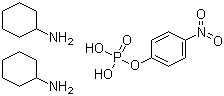 |
| Molecular Formula | 2(C6H13N).C6H6NO6P |
| Molecular Weight | 417.44 |
| CAS Registry Number | 52483-84-8 |
| EC Number | 257-949-0 |
| SMILES | C1CCC(CC1)N.C1CCC(CC1)N.C1=CC(=CC=C1[N+](=O)[O-])OP(=O)(O)O |
| Hazard Symbols |  GHS07 Warning Details GHS07 Warning Details | ||||||||||||||||
|---|---|---|---|---|---|---|---|---|---|---|---|---|---|---|---|---|---|
| Risk Statements | H315-H319-H335 Details | ||||||||||||||||
| Safety Statements | P261-P264-P264+P265-P271-P280-P302+P352-P304+P340-P305+P351+P338-P319-P321-P332+P317-P337+P317-P362+P364-P403+P233-P405-P501 Details | ||||||||||||||||
| Hazard Classification | |||||||||||||||||
| |||||||||||||||||
| SDS | Available | ||||||||||||||||
 chemBlink Chemical Story
|
4-Nitrophenyl phosphate bis(cyclohexylammonium) salt is an organic phosphate ester salt commonly used as a chromogenic substrate for phosphatase enzymes in biochemical assays. The compound consists of a 4-nitrophenyl phosphate anion paired with two cyclohexylammonium cations, forming a stabilized ionic solid with enhanced handling and solubility properties for laboratory use. The core structural unit is 4-nitrophenyl phosphate, a phosphate monoester derived from 4-nitrophenol. It contains a benzene ring substituted at the para position with a nitro group (–NO2) and an oxygen-linked phosphate group (–O–PO3H2 in its protonated form). The aromatic ring is planar and features a delocalized π-electron system, while the nitro group is strongly electron-withdrawing, influencing the electronic distribution of the ring and stabilizing the phenolate form of the enzymatic product. The phosphate group consists of a central phosphorus atom tetrahedrally coordinated to four oxygen atoms. In the bis(cyclohexylammonium) salt, two of these oxygen atoms are deprotonated, giving the phosphate moiety a net negative charge that is balanced by two cyclohexylammonium cations. This ionic arrangement enhances crystalline stability and water compatibility. Cyclohexylammonium ions are protonated forms of cyclohexylamine, in which the nitrogen atom bears a positive charge (–NH3+ or protonated amine form depending on context) and is attached to a saturated cyclohexyl ring. The cyclohexyl group is a non-aromatic, conformationally flexible six-membered carbon ring that typically adopts a chair conformation. These cations contribute hydrophobic character relative to smaller inorganic counterions while still providing ionic stabilization through electrostatic interaction with the phosphate anion. The key reactive feature of the molecule is the phosphate ester bond linking the aromatic oxygen to the phosphate group. This bond is selectively cleaved by phosphatase enzymes, which catalyze hydrolysis of phosphate monoesters. The enzymatic reaction releases free 4-nitrophenol and inorganic phosphate. The liberated 4-nitrophenol can undergo deprotonation under alkaline conditions to form 4-nitrophenolate, a strongly yellow chromophore. The nitro substituent at the para position plays an essential role in stabilizing the chromogenic product. Through strong electron-withdrawing effects, it enhances the acidity of 4-nitrophenol and stabilizes the negative charge in the phenolate form via resonance. This electronic stabilization is responsible for the intense visible absorption used in spectrophotometric detection. From a structural perspective, the phosphate ester linkage is the most chemically significant bond in the substrate. It is stable under neutral conditions but readily hydrolyzed in the presence of phosphatase enzymes. The aromatic system remains intact during the reaction, serving primarily as a reporter group for color development. Physicochemically, the compound is highly polar and water-compatible due to its ionic phosphate group and ammonium counterions. The aromatic portion contributes limited hydrophobic character, while the cyclohexylammonium groups introduce organic bulk and moderate hydrophobicity compared with inorganic salts. The cyclohexylammonium cations do not participate directly in the enzymatic reaction but influence solubility, crystallization, and storage stability. Their organic nature can also affect dissolution behavior in aqueous buffer systems used in biochemical assays. Chemically, the most important transformation is enzymatic cleavage of the phosphate ester bond. The phosphate group itself is relatively stable outside enzymatic or strongly acidic/basic conditions. The nitro-substituted aromatic ring is chemically stable under assay conditions and primarily functions as a chromogenic reporter system. Overall, 4-nitrophenyl phosphate bis(cyclohexylammonium) salt is a water-soluble phosphate ester composed of a para-nitrophenyl group linked to a phosphate dianion stabilized by cyclohexylammonium counterions. Its design enables selective enzymatic hydrolysis and the generation of a measurable yellow chromophore, making it a widely used reagent for phosphatase activity assays in biochemical research. |
| Market Analysis Reports |