
Online Database of Chemicals from Around the World
| Simagchem Corporation | China | |||
|---|---|---|---|---|
 | www.simagchem.com | |||
 | +86 13806087780 | |||
 | +86 (592) 268-0237 | |||
 | sale@simagchem.com | |||
| Chemical manufacturer since 2002 | ||||
| chemBlink Standard supplier since 2008 | ||||
| HuNan Huibaiyi New Materials Co; Ltd. | China | |||
|---|---|---|---|---|
| www.hbsjxcl.com | |||
| +86 13319523173 | |||
| ivy@hnhbsj.com | |||
 | QQ Chat | |||
 | WeChat: 13319523173 | |||
| Chemical manufacturer since 2014 | ||||
| chemBlink Standard supplier since 2026 | ||||
| Combi-Blocks, Inc. | USA | |||
|---|---|---|---|---|
| www.combi-blocks.com | |||
| +1 (858) 635-8950 | |||
| +1 (858) 635-8991 | |||
| sales@combi-blocks.com | |||
| Chemical manufacturer | ||||
| Apollo Scientific Ltd. | UK | |||
|---|---|---|---|---|
| www.apolloscientific.co.uk | |||
| +44 (161) 406-0505 | |||
| +44 (161) 406-0506 | |||
| sales@apolloscientific.co.uk | |||
| Chemical manufacturer | ||||
| Indofine Chemical Company, Inc. | USA | |||
|---|---|---|---|---|
| www.indofinechemical.com | |||
| +1 (888) 463-6346 | |||
| +1 (908) 359-1179 | |||
| info@indofinechemical.com | |||
| Chemical manufacturer since 1981 | ||||
| Melford Laboratories Limited | UK | |||
|---|---|---|---|---|
| www.melford.co.uk | |||
| +44 (1449) 741-178 | |||
| +44 (1449) 741-217 | |||
| pfranklin@melford.co.uk sales@melford.co.uk | |||
| Chemical manufacturer since 1985 | ||||
| Ryan Scientific, Inc. | USA | |||
|---|---|---|---|---|
| www.ryansci.com | |||
| +1 (843)-884-4911 | |||
| +1 (843) 884-5568 | |||
| sales@ryansci.com | |||
| Chemical manufacturer | ||||
| Anvia Chemicals, LLC | USA | |||
|---|---|---|---|---|
| www.anviachem.com | |||
| +1 (414) 534-7845 | |||
| +1 (414) 762-5539 | |||
| sales@anviachem.com | |||
| Chemical manufacturer | ||||
| Classification | Chemical reagent >> Organic reagent >> Azo, diazonium compound |
|---|---|
| Name | 4-Nitrophenyl phosphate disodium salt hexahydrate |
| Molecular Structure | 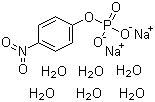 |
| Molecular Formula | C6H4NNa2O6P.6(H2O) |
| Molecular Weight | 371.14 |
| CAS Registry Number | 333338-18-4 |
| EC Number | 886-059-0 |
| SMILES | C1=CC(=CC=C1[N+](=O)[O-])OP(=O)([O-])[O-].O.O.O.O.O.O.[Na+].[Na+] |
| Hazard Symbols |  GHS07 Warning Details GHS07 Warning Details |
|---|---|
| Risk Statements | H302-H315-H319-H332-H335 Details |
| Safety Statements | P233-P260-P261-P264-P270-P271-P280-P301+P312-P302+P352-P304-P304+P340-P305+P351+P338-P312-P321-P330-P332+P313-P337+P313-P340-P362-P403-P403+P233-P405-P501 Details |
| SDS | Available |
 chemBlink Chemical Story
|
4-Nitrophenyl phosphate disodium salt hexahydrate is an organic phosphate ester commonly used as a chromogenic substrate in biochemical assays for phosphatase enzymes. The compound consists of a para-nitrophenyl group linked through an oxygen atom to a phosphate group, present as a disodium salt with six molecules of crystallization water. Its primary function in laboratory chemistry is to serve as a substrate that releases a colored product upon enzymatic hydrolysis. Structurally, the molecule contains a benzene ring substituted at the para position with a nitro group (–NO2) and an oxygen-linked phosphate ester group (–O–PO3H2 in neutral form). The aromatic ring provides a rigid, planar framework with delocalized π-electrons, while the nitro group is a strongly electron-withdrawing substituent that influences the electronic distribution of the ring and stabilizes the phenoxide form of the product after hydrolysis. The phosphate group is the key functional unit for enzymatic recognition. It consists of a central phosphorus atom tetrahedrally coordinated to four oxygen atoms. In the disodium salt form, two of these oxygen atoms are deprotonated and associated with sodium cations, resulting in an overall ionic structure. This ionic nature significantly increases aqueous solubility and ensures compatibility with biological assay conditions. The glycosidic-like phosphate ester bond between the aromatic oxygen and the phosphate group is the site of enzymatic cleavage. Phosphatase enzymes catalyze hydrolysis of this bond, releasing free 4-nitrophenol and inorganic phosphate. The reaction is highly specific and is widely used to measure phosphatase activity in biological samples. Upon enzymatic hydrolysis, 4-nitrophenol is liberated. Under alkaline conditions, it can deprotonate to form the 4-nitrophenolate ion, which exhibits a strong yellow color due to extended conjugation and altered electron distribution in the aromatic system. This chromogenic transition enables spectrophotometric quantification of enzymatic activity. The hexahydrate form of the compound includes six water molecules associated with the crystalline lattice. These water molecules are not covalently bound but are integrated into the crystal structure through hydrogen bonding and ionic interactions with phosphate oxygen atoms and sodium ions. Hydration influences physical properties such as stability, crystallinity, and solubility. From a physicochemical perspective, 4-nitrophenyl phosphate disodium salt hexahydrate is highly polar and water soluble due to its ionic phosphate groups and sodium counterions. The aromatic portion contributes limited hydrophobic character, but the overall molecule is dominated by its ionic and hydrogen-bonding functionality. Chemically, the phosphate ester bond is relatively stable under neutral conditions but is readily cleaved by phosphatase enzymes. The nitro substituent on the aromatic ring is not directly involved in enzymatic cleavage but plays a critical role in stabilizing the chromogenic product after hydrolysis. The sodium ions primarily serve as charge-balancing counterions and facilitate dissolution in aqueous media. They do not participate directly in the enzymatic reaction but influence solubility and ionic strength of the solution. Overall, 4-nitrophenyl phosphate disodium salt hexahydrate is a water-soluble phosphate ester composed of a para-nitrophenyl group linked to a phosphate moiety stabilized by sodium ions and water of crystallization. Its ability to produce a measurable color change upon enzymatic dephosphorylation makes it a widely used reagent in phosphatase activity assays in biochemistry and molecular biology. References 2026. Bioactive Substances Characterization in Probiotic-Fermented Guava (Psidium guajava L.) Juice and Systematic Evaluation of its Anti-Hyperglycemic Activity. Plant foods for human nutrition (Dordrecht, Netherlands). DOI: 10.1007/s11130-025-01466-w 2026. Green Compost Effectiveness in Improving Quality of an Agricultural Soil Co-contaminated by Antibiotics and Copper. Journal of Soil Science and Plant Nutrition. DOI: 10.1007/s42729-026-03008-y 2026. Low oxidative stress of cephalopod early life stages under chronic and intermittent hypoxia. Marine Biology. DOI: 10.1007/s00227-025-04779-1 |
| Market Analysis Reports |