
Online Database of Chemicals from Around the World
| AAT Bioquest, Inc. | USA | |||
|---|---|---|---|---|
 | www.aatbio.com | |||
 | +1 (408) 733-1055 | |||
 | +1 (408) 733-1304 | |||
 | jack@aatbio.com | |||
| Chemical manufacturer since 2005 | ||||
| chemBlink Standard supplier since 2010 | ||||
| Hangzhou Leap Chem Co., Ltd. | China | |||
|---|---|---|---|---|
| www.leapchem.com | |||
| +86 (571) 8771-1850 | |||
| market19@leapchem.com | |||
 | QQ Chat | |||
| Chemical manufacturer since 2006 | ||||
| chemBlink Standard supplier since 2015 | ||||
| Amadis Chemical Co., Ltd. | China | |||
|---|---|---|---|---|
| www.amadischem.com | |||
| +86 (571) 8992-5085 | |||
| +86 (571) 8992-5065 | |||
| sales@amadischem.com | |||
| Chemical manufacturer since 2010 | ||||
| chemBlink Standard supplier since 2015 | ||||
| Wonderchem Co., Limited | Hong Kong | |||
|---|---|---|---|---|
| www.wonder-chem.com | |||
| +852 8192-5218 | |||
| sales@wonder-chem.com | |||
| Chemical distributor since 2016 | ||||
| chemBlink Standard supplier since 2017 | ||||
| HuNan Huibaiyi New Materials Co; Ltd. | China | |||
|---|---|---|---|---|
| www.hbsjxcl.com | |||
| +86 13319523173 | |||
| ivy@hnhbsj.com | |||
| QQ Chat | |||
 | WeChat: 13319523173 | |||
| Chemical manufacturer since 2014 | ||||
| chemBlink Standard supplier since 2026 | ||||
| Cayman Chemical Company | USA | |||
|---|---|---|---|---|
| www.caymanchem.com | |||
| +1 (734) 971-3335 | |||
| +1 (734) 971-3640 | |||
| sales@caymanchem.com | |||
| Chemical manufacturer | ||||
| Classification | Organic raw materials >> Carboxylic compounds and derivatives >> Carboxylic esters and their derivatives |
|---|---|
| Name | 2,7-Dichlorodihydrofluorescein diacetate |
| Molecular Structure | 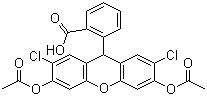 |
| Molecular Formula | C24H16Cl2O7 |
| Molecular Weight | 487.29 |
| CAS Registry Number | 4091-99-0 |
| EC Number | 685-843-8 |
| SMILES | CC(=O)OC1=C(C=C2C(C3=CC(=C(C=C3OC2=C1)OC(=O)C)Cl)C4=CC=CC=C4C(=O)O)Cl |
| Density | 1.5±0.1 g/cm3 Calc.* |
|---|---|
| Boiling point | 593.5±50.0 °C 760 mmHg (Calc.)* |
| Flash point | 312.7±30.1 °C (Calc.)* |
| Solubility | Soluble DMSO: 100 mM, ethanol: 10 mM (Expl.) |
| Index of refraction | 1.635 (Calc.)* |
| * | Calculated using Advanced Chemistry Development (ACD/Labs) Software. |
| Hazard Symbols |  GHS07 Warning Details GHS07 Warning Details | ||||||||||||||||
|---|---|---|---|---|---|---|---|---|---|---|---|---|---|---|---|---|---|
| Risk Statements | H315-H319-H335 Details | ||||||||||||||||
| Safety Statements | P261-P264-P264+P265-P271-P280-P302+P352-P304+P340-P305+P351+P338-P319-P321-P332+P317-P337+P317-P362+P364-P403+P233-P405-P501 Details | ||||||||||||||||
| Hazard Classification | |||||||||||||||||
| |||||||||||||||||
| SDS | Available | ||||||||||||||||
 chemBlink Chemical Story
|
2,7-Dichlorodihydrofluorescein diacetate is a synthetic, non-fluorescent fluorogenic probe derived from fluorescein. It is widely used in biochemical and cellular assays to detect the presence of reactive oxygen species (ROS) after intracellular enzymatic activation and oxidation. The compound belongs to the diacetylated dihydrofluorescein class of dyes, which function as redox-sensitive indicators. Structurally, the molecule is based on the fluorescein framework, a xanthene–benzene fused ring system that forms the core of many fluorescent dyes. In this derivative, the fluorescein structure is modified in two key ways: reduction of the central xanthene system to the dihydro form and substitution with chlorine atoms at the 2 and 7 positions of the aromatic system. These chlorine substituents influence the electronic distribution of the aromatic rings through inductive electron-withdrawing effects. The dihydrofluorescein core differs from fluorescein in that the central xanthene system is in a reduced, non-conjugated state. This disruption of conjugation eliminates fluorescence in the native compound. As a result, 2,7-dichlorodihydrofluorescein diacetate is essentially non-fluorescent until it undergoes oxidation and enzymatic processing within cells. Two acetate groups are attached to phenolic oxygen atoms of the fluorescein backbone, forming diacetate esters. These acetyl groups mask the polar hydroxyl functionalities, increasing the molecule’s lipophilicity and allowing it to passively diffuse across cell membranes. Once inside cells, intracellular esterases hydrolyze the acetate groups, converting the compound into the more polar dihydrofluorescein form, which becomes trapped within the cell. The chlorine substituents at the 2 and 7 positions play an important role in modulating the redox and spectral properties of the molecule. Halogen atoms are electron-withdrawing and influence the oxidation potential of the dye, as well as the photophysical properties of the oxidized fluorescent product. The key functional transformation of this compound occurs in two sequential steps. First, enzymatic cleavage of the acetate groups by cellular esterases produces 2,7-dichlorodihydrofluorescein. This deacetylated form is still non-fluorescent but is now trapped within the cell due to increased polarity. Second, oxidation by reactive oxygen species converts the reduced xanthene system into the fully conjugated fluorescein-like structure. This oxidation restores extended π-conjugation across the xanthene system, enabling strong fluorescence. The intensity of fluorescence generated is proportional to the level of oxidative species present, which is why the compound is widely used as a general oxidative stress indicator in biological systems. From a physicochemical perspective, the diacetate form is relatively hydrophobic due to masking of hydroxyl groups by acetate esters. This property facilitates membrane permeability. After hydrolysis, the resulting compound becomes more hydrophilic and less membrane-permeable, leading to intracellular retention. Chemically, the ester groups are the most labile features under biological conditions, being readily cleaved by nonspecific intracellular esterases. The reduced xanthene core is susceptible to oxidation, which is the key signal-generating reaction. The aromatic chlorinated positions remain chemically stable during these transformations. Overall, 2,7-dichlorodihydrofluorescein diacetate is a masked, cell-permeable fluorescent probe designed to undergo enzymatic activation and oxidative conversion to a fluorescent product. Its structure integrates a reduced fluorescein core, halogen substitution, and acetate masking groups, enabling it to function as a widely used indicator of intracellular oxidative activity. References 2026. Plastid-encoded Ycf10 maintains chloroplast proton homeostasis essential for photosynthesis in Chlamydomonas reinhardtii. npj Science of Plants. DOI: 10.1038/s44383-026-00025-9 2026. Reactive oxygen species-evoked endoplasmic reticulum stress mediates albumin load-induced epithelial-mesenchymal transition in podocytes. Molecular Biology Reports. DOI: 10.1007/s11033-026-11582-8 2026. Bioprocessing and Functional Characterization of Hibiscus Hamabo Root Culture Bioactives: Antioxidant and Moisturizing Effects with Surfactin-Enhanced Penetration in Artificial Skin Models. Applied Biochemistry and Biotechnology. DOI: 10.1007/s12010-026-05611-2 |
| Market Analysis Reports |