
Online Database of Chemicals from Around the World
| Nanjing Search Biotech Co., Ltd. | China | |||
|---|---|---|---|---|
 | www.searchbio.com.cn | |||
 | +86 (25) 8168-2922 8586-0978 +86 18913919581 | |||
 | +86 (25) 8586-0962 | |||
 | trade@searchbio.com.cn sales@searchbio.com.cn Linda@searchbio.com.cn | |||
 | QQ Chat | |||
| Chemical manufacturer since 2007 | ||||
| chemBlink Standard supplier since 2007 | ||||
| Intatrade Chemicals GmbH | Germany | |||
|---|---|---|---|---|
| www.intatrade.de | |||
| +49 (3493) 605-465 | |||
| +49 (3493) 605-470 | |||
| sales@intatrade.de | |||
| Chemical distributor | ||||
| chemBlink Standard supplier since 2011 | ||||
| LOBA Feinchemie AG | Austria | |||
|---|---|---|---|---|
| www.loba.co.at | |||
| +43 (223) 277-391 | |||
| +43 (223) 276-677 | |||
| sales@loba.co.at | |||
| Chemical distributor | ||||
| chemBlink Standard supplier since 2012 | ||||
| Hangzhou Leap Chem Co., Ltd. | China | |||
|---|---|---|---|---|
| www.leapchem.com | |||
| +86 (571) 8771-1850 | |||
| market19@leapchem.com | |||
| QQ Chat | |||
| Chemical manufacturer since 2006 | ||||
| chemBlink Standard supplier since 2015 | ||||
| Hunan Yunbang Biomedical Co., Ltd. | China | |||
|---|---|---|---|---|
| www.hunanyunbang.com | |||
| +86 (731) 8552-5705 +86 13319518603 | |||
| +86 (731) 8552-5705 | |||
| ivy@hnhbsj.com | |||
| QQ Chat | |||
 | Skype Chat | |||
| Chemical manufacturer since 2014 | ||||
| chemBlink Standard supplier since 2019 | ||||
| R&D Scientific Inc. | Canada | |||
|---|---|---|---|---|
| www.rdscientific.com | |||
| +1 (226) 600-0236 | |||
| sales@rdscientific.com | |||
| Chemical manufacturer since 2016 | ||||
| chemBlink Standard supplier since 2023 | ||||
| HuNan Huibaiyi New Materials Co; Ltd. | China | |||
|---|---|---|---|---|
| www.hbsjxcl.com | |||
| +86 13319523173 | |||
| ivy@hnhbsj.com | |||
| QQ Chat | |||
 | WeChat: 13319523173 | |||
| Chemical manufacturer since 2014 | ||||
| chemBlink Standard supplier since 2026 | ||||
| Dojindo Molecular Technologies, Inc. | USA | |||
|---|---|---|---|---|
| www.dojindo.com | |||
| +1 (301) 987-2667 | |||
| +1 (301) 987-2687 | |||
| info@dojindo.com | |||
| Chemical manufacturer | ||||
| Chemos GmbH & Co. KG | Germany | |||
|---|---|---|---|---|
| www.chemos.de | |||
| +49 871-966346-0 | |||
| +49 871-966346-13 | |||
| chemos@chemos.de | |||
| Chemical distributor | ||||
| Indofine Chemical Company, Inc. | USA | |||
|---|---|---|---|---|
| www.indofinechemical.com | |||
| +1 (888) 463-6346 | |||
| +1 (908) 359-1179 | |||
| info@indofinechemical.com | |||
| Chemical manufacturer since 1981 | ||||
| Nanjing Greensynthesis Biochemical Co., Ltd. | China | |||
|---|---|---|---|---|
| www.greensynchem.com | |||
| +86 (25) 8549-3277 | |||
| +86 (25) 8330-2337 | |||
| sales@greensynchem.com | |||
| Chemical manufacturer since 2003 | ||||
| Syntech Labs, Inc. | USA | |||
|---|---|---|---|---|
| www.syntechlabs.com | |||
| +1 (732) 545-8380 | |||
| +1 (732) 545-6881 | |||
| info@syntechlabs.com | |||
| Chemical manufacturer | ||||
| Beijing Solarbio Science & Technology Co., Ltd. | China | |||
|---|---|---|---|---|
| www.solarbio.cn | |||
| +86 (10) 8821-0199 | |||
| +86 (10) 8821-0286 | |||
| solarbio@163.com | |||
| Chemical manufacturer | ||||
| Melford Laboratories Limited | UK | |||
|---|---|---|---|---|
| www.melford.co.uk | |||
| +44 (1449) 741-178 | |||
| +44 (1449) 741-217 | |||
| pfranklin@melford.co.uk sales@melford.co.uk | |||
| Chemical manufacturer since 1985 | ||||
| Classification | Chemical reagent >> Organic reagent >> Azo, diazonium compound |
|---|---|
| Name | Thiazolyl Blue |
| Synonyms | 3-(4,5-Dimethyl-2-thiazolyl)-2,5-diphenyl-2H-tetrazolium bromide; Methylthiazolyldiphenyl-tetrazolium bromide; Thiazolyl Blue Tetrazolium Bromide; MTT |
| Molecular Structure | 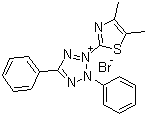 |
| Molecular Formula | C18H16BrN5S |
| Molecular Weight | 414.32 |
| CAS Registry Number | 298-93-1 |
| EC Number | 206-069-5 |
| SMILES | CC1=C(SC(=N1)[N+]2=NC(=NN2C3=CC=CC=C3)C4=CC=CC=C4)C.[Br-] |
| Melting point | 195 °C (Decomposes) (Expl.) |
|---|---|
| Solubility | Soluble water:5 mg/mL, DMSO: 32mg/mL (Expl.) |
| Hazard Symbols |   GHS07;GHS08 Warning Details GHS07;GHS08 Warning Details | ||||||||||||||||||||||||||||||||||||
|---|---|---|---|---|---|---|---|---|---|---|---|---|---|---|---|---|---|---|---|---|---|---|---|---|---|---|---|---|---|---|---|---|---|---|---|---|---|
| Risk Statements | H315-H319-H335-H341 Details | ||||||||||||||||||||||||||||||||||||
| Safety Statements | P203-P261-P264-P264+P265-P271-P280-P302+P352-P304+P340-P305+P351+P338-P318-P319-P321-P332+P317-P337+P317-P362+P364-P403+P233-P405-P501 Details | ||||||||||||||||||||||||||||||||||||
| Hazard Classification | |||||||||||||||||||||||||||||||||||||
| |||||||||||||||||||||||||||||||||||||
| SDS | Available | ||||||||||||||||||||||||||||||||||||
 chemBlink Chemical Story
|
Thiazolyl Blue, commonly known as MTT and chemically identified as 3-(4,5-dimethylthiazol-2-yl)-2,5-diphenyltetrazolium bromide, is a synthetic tetrazolium salt widely used as a chromogenic reagent in cell biology and biochemistry. The compound is best known for its use in viability and metabolic activity assays, where it serves as a substrate that can be reduced by metabolically active cells to produce colored products. Structurally, the molecule contains a tetrazolium core, which is a five-membered heterocyclic ring containing four nitrogen atoms and one carbon atom. Tetrazolium systems possess extensive electron delocalization and carry a formal positive charge distributed throughout the ring. This positively charged heterocycle is responsible for the characteristic redox behavior of the compound. Attached to the tetrazolium core are aromatic substituents that modify its electronic and physicochemical properties. Two phenyl rings are attached at the 2- and 5-positions of the tetrazolium ring. These benzene rings contribute hydrophobic surface area and extend the π-electron system of the molecule. The aromatic groups influence electron distribution and help stabilize the conjugated structure. At the 3-position of the tetrazolium ring is a 4,5-dimethylthiazol-2-yl substituent. Thiazole is a five-membered aromatic heterocycle containing one sulfur atom and one nitrogen atom. The aromaticity of the thiazole ring contributes additional electron delocalization, while the methyl substituents increase hydrophobic character and slightly alter the electronic properties of the heterocycle. The molecule is commonly isolated as a bromide salt. Bromide acts as a counterion balancing the positive charge of the tetrazolium system. In aqueous environments, the bromide ion generally dissociates from the tetrazolium cation and participates primarily through electrostatic interactions rather than covalent bonding. From an electronic perspective, Thiazolyl Blue possesses an extended conjugated system involving the tetrazolium ring, aromatic substituents, and thiazole ring. This extensive delocalization contributes to the optical properties of the compound and underlies its behavior in colorimetric assays. The most important chemical characteristic of Thiazolyl Blue is its redox activity. Tetrazolium salts can accept electrons and undergo reduction reactions. In biological systems, metabolically active cells reduce MTT through cellular oxidoreductase activity, generating insoluble purple formazan products. The reduction process changes both the electronic structure and color of the molecule, creating the basis for quantitative colorimetric measurements. The conversion from tetrazolium to formazan involves reduction of the positively charged tetrazolium ring to a neutral, highly conjugated product. Formazan derivatives possess different absorption properties and display strong visible coloration. The amount of formazan generated is commonly used as an indirect measure of cellular metabolic activity. Physicochemically, Thiazolyl Blue exhibits both hydrophobic and ionic characteristics. The aromatic rings contribute hydrophobic properties, whereas the positively charged tetrazolium center contributes ionic behavior. The balance of these features affects solubility and interactions with biological systems. Chemically, the tetrazolium ring is the most reactive region of the molecule. Reduction readily alters its electronic structure, whereas the aromatic substituents and thiazole ring remain comparatively stable under ordinary conditions. Overall, Thiazolyl Blue is a substituted tetrazolium compound containing a positively charged nitrogen-rich heterocycle linked to phenyl and thiazole aromatic systems. Its ability to undergo reduction into colored formazan products forms the basis of its widespread use in biochemical and cell-based analytical methods. References 2026. Author Correction: Development of Gold coated calcium peroxide nanoparticles for photothermal ferroptosis against skin cancer and C. albicans. Communications Chemistry. DOI: 10.1038/s42004-025-01878-4 2025. Synthesis and structure-activity relationship evaluation of hypoglycemic activity of novel borneol and isoborneol containing (hydroxyphenyl)propanoic acids as FFAR1 agonists. Medicinal Chemistry Research. DOI: 10.1007/s00044-026-03532-7 2026. Engineered levothyroxine dry powder for inhalation to treat idiopathic pulmonary fibrosis. Drug Delivery and Translational Research. DOI: 10.1007/s13346-026-02064-2 |
| Market Analysis Reports |