
Online Database of Chemicals from Around the World
| Laizhou Laiyu Chemical Co., Ltd. | China | |||
|---|---|---|---|---|
 | www.laiyu.com | |||
 | +86 (535) 271-9337 | |||
 | liyunxia0707@163.com | |||
 | QQ Chat | |||
 | WeChat: 15864067774 | |||
 | WhatsApp:8615864067774 | |||
| Chemical manufacturer since 1998 | ||||
| chemBlink Standard supplier since 2008 | ||||
| Simagchem Corporation | China | |||
|---|---|---|---|---|
| www.simagchem.com | |||
| +86 13806087780 | |||
 | +86 (592) 268-0237 | |||
| sale@simagchem.com | |||
| Chemical manufacturer since 2002 | ||||
| chemBlink Standard supplier since 2008 | ||||
| Hefei TNJ Chemical Industry Co., Ltd. | China | |||
|---|---|---|---|---|
| www.tnjchem.com | |||
| +86 (551) 6541-8684 | |||
| +86 (551) 6541-8697 | |||
| sales@tnjchem.com | |||
| Chemical manufacturer since 2001 | ||||
| chemBlink Standard supplier since 2010 | ||||
| BOC Sciences | USA | |||
|---|---|---|---|---|
| www.bocsci.com | |||
| +1 (631) 485-4226 | |||
| +1 (631) 614-7828 | |||
| info@bocsci.com | |||
| Chemical manufacturer | ||||
| chemBlink Standard supplier since 2010 | ||||
| Hangzhou Leap Chem Co., Ltd. | China | |||
|---|---|---|---|---|
| www.leapchem.com | |||
| +86 (571) 8771-1850 | |||
| market19@leapchem.com | |||
| QQ Chat | |||
| Chemical manufacturer since 2006 | ||||
| chemBlink Standard supplier since 2015 | ||||
| Yantai Topway Industrial Co., Ltd. | China | |||
|---|---|---|---|---|
| www.topway.biz | |||
| +86 (535) 661-5990 | |||
| +86 (535) 662-5679 | |||
| yttopway@163.com | |||
| Chemical manufacturer since 1998 | ||||
| chemBlink Standard supplier since 2016 | ||||
| Chengdu Yuanda Chemical Co., Ltd. | China | |||
|---|---|---|---|---|
| www.ydachem.com | |||
| +86 (28) 8535-6300 | |||
| +86 (28) 8535-6300 | |||
| sales@ydachem.com | |||
| Chemical manufacturer since 2009 | ||||
| chemBlink Standard supplier since 2017 | ||||
| Qingdao Highcloud Tech Material Co., Ltd. | China | |||
|---|---|---|---|---|
| www.highcloudtech.com.cn | |||
| +86 86-15864067774 | |||
| info@highcloudtech.com.cn | |||
| QQ Chat | |||
| WeChat: 8615864067774 | |||
| WhatsApp:8615864067774 | |||
| Chemical manufacturer since 2023 | ||||
| chemBlink Standard supplier since 2026 | ||||
| Classification | Natural product >> Natural phenols |
|---|---|
| Name | Diallyl bisphenol A |
| Synonyms | 2,2'-Diallylbisphenol A; 4,4'-Isopropylidenebis(2-allylphenol); 4,4'-(1-Methylethylidene)bis[2-(2-propenyl)]phenol; DBA; O-DABPA |
| Molecular Structure | 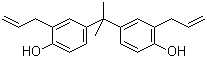 |
| Molecular Formula | C21H24O2 |
| Molecular Weight | 308.41 |
| CAS Registry Number | 1745-89-7 |
| EC Number | 217-121-1 |
| SMILES | CC(C)(C1=CC(=C(C=C1)O)CC=C)C2=CC(=C(C=C2)O)CC=C |
| Density | 1.1±0.1 g/cm3 Calc.* |
|---|---|
| Boiling point | 445.2±40.0 °C 760 mmHg (Calc.)* |
| Flash point | 199.1±21.9 °C (Calc.)* |
| Index of refraction | 1.58 (Calc.)* |
| * | Calculated using Advanced Chemistry Development (ACD/Labs) Software. |
| Hazard Symbols |    GHS05;GHS07;GHS09 Danger Details GHS05;GHS07;GHS09 Danger Details | ||||||||||||||||||||||||||||||||||||||||
|---|---|---|---|---|---|---|---|---|---|---|---|---|---|---|---|---|---|---|---|---|---|---|---|---|---|---|---|---|---|---|---|---|---|---|---|---|---|---|---|---|---|
| Risk Statements | H314-H317-H318-H400-H410 Details | ||||||||||||||||||||||||||||||||||||||||
| Safety Statements | P260-P261-P264-P264+P265-P272-P273-P280-P301+P330+P331-P302+P352-P302+P361+P354-P304+P340-P305+P354+P338-P316-P317-P321-P333+P317-P362+P364-P363-P391-P405-P501 Details | ||||||||||||||||||||||||||||||||||||||||
| Hazard Classification | |||||||||||||||||||||||||||||||||||||||||
| |||||||||||||||||||||||||||||||||||||||||
| Transport Information | UN 1760 | ||||||||||||||||||||||||||||||||||||||||
| SDS | Available | ||||||||||||||||||||||||||||||||||||||||
 chemBlink Chemical Story
|
Diallyl bisphenol A is a multifunctional aromatic compound derived from bisphenol A in which both phenolic hydroxyl groups are converted into allyl ether functionalities. The compound contains a central bisphenol A framework together with two terminal allyl groups, resulting in a structure that combines aromatic rigidity with reactive unsaturated substituents. Because of the presence of two allyl groups, the molecule is classified as a difunctional allyl ether. The central structural framework originates from bisphenol A, which consists of two phenyl rings connected through an isopropylidene bridge, represented by a central carbon bonded to two methyl groups. This bridge creates a relatively rigid three-dimensional arrangement and introduces steric separation between the two aromatic rings. The aromatic rings retain extensive π-electron delocalization and contribute hydrophobic character and structural stability. In diallyl bisphenol A, the hydroxyl groups originally present on the bisphenol A structure are transformed into allyl ether substituents. An allyl group consists of a carbon chain with the structure –CH2–CH=CH2. Attachment through oxygen forms an allyl ether linkage, giving the substituent the structure –O–CH2–CH=CH2. The oxygen atom introduces localized polarity and hydrogen-bond-accepting capability, while the allyl group provides reactive unsaturated carbon–carbon double bonds. The two allyl groups represent the most chemically active portions of the molecule. Carbon–carbon double bonds can undergo numerous reactions, including radical polymerization, addition reactions, oxidation, and thermal rearrangements under suitable conditions. The presence of two allyl functionalities allows the compound to participate in crosslinking reactions, making it capable of forming polymeric networks. From a structural perspective, the molecule combines rigid aromatic regions with flexible side chains. The aromatic rings and central isopropylidene bridge provide a relatively fixed molecular backbone, whereas the allyl ether groups retain rotational freedom around carbon–oxygen and carbon–carbon single bonds. This combination creates a molecular architecture with both defined structural features and localized flexibility. Electronically, the molecule contains several distinct regions. The aromatic rings possess delocalized π-electron systems, while each allyl group contains an additional localized π-bond associated with the alkene. The ether oxygen atoms slightly modify electron distribution through inductive and resonance effects. Physicochemically, diallyl bisphenol A is predominantly hydrophobic because of the large aromatic hydrocarbon framework and alkyl substituents. The ether oxygen atoms contribute some polarity, but the overall molecule contains limited strongly polar functionality. Consequently, its behavior is generally dominated by the aromatic and hydrocarbon portions of the structure. Chemically, the allyl groups are more reactive than the aromatic core. Under radical conditions, the double bonds can participate in polymerization or crosslinking reactions. The aromatic rings themselves are relatively stable under normal conditions but can undergo electrophilic substitution reactions under appropriate circumstances. Ether linkages are generally stable under neutral conditions but may undergo cleavage under strongly acidic environments. Overall, diallyl bisphenol A is a difunctional allyl ether derivative of bisphenol A composed of a rigid aromatic backbone linked to two reactive allyl groups. Its molecular architecture combines aromatic stability with alkene reactivity, providing a balance of structural rigidity and functional versatility. References 2025. Functionalized carbon nanotubes: synthesis, properties, and application in polymer for flame retardancy—a review. Journal of Thermal Analysis and Calorimetry. DOI: 10.1007/s10973-025-14016-y 2023. Continuous flow process development for the synthesis of an industrial raw material via solvent-free aromatic Claisen rearrangement. Journal of Flow Chemistry. DOI: 10.1007/s41981-023-00275-z 2023. Preparation of high-performance thermosetting films from novel diallyl bisphenol A/furfurylamine type benzoxazine and oligo(phenylene oxide). Journal of Polymer Research. DOI: 10.1007/s10965-023-03520-0 |
| Market Analysis Reports |