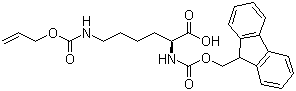
A lysine residue offers two amino groups, which is useful only if a chemist can decide which one reacts. N-Fmoc-N'-allyloxycarbonyl-L-lysine, CAS 146982-27-6, provides two different temporary masks for that purpose. Commonly written Fmoc-Lys(Alloc)-OH, it is a building block for distinguishing backbone growth from chemistry on the end of the lysine side chain.
The alpha-amino group sits beside the carboxyl group and normally participates in the peptide backbone. The epsilon-amino group lies at the end of a four-methylene side chain. In this derivative, Fmoc protects the former and allyloxycarbonyl, abbreviated Alloc or Aloc, protects the latter. The carboxyl group remains available for coupling. The locations of the two groups matter: reversing them would define a different reagent with a different synthetic purpose.
This design embodies orthogonal protection. Two groups are orthogonal when appropriately chosen conditions can remove one while retaining the other groups required at that stage. The concept does not mean that either group survives every possible reagent or that a procedure works without regard to the rest of the molecule. It means that a usable difference in chemical response has been built into the synthesis plan.
Fmoc is removed through base-sensitive chemistry. Alloc instead offers an allyl-based route to deprotection, commonly involving palladium-mediated chemistry. The contrast can make the side-chain amine accessible without deliberately uncovering the backbone amine at the same time. Such selective access is valuable when a peptide needs a branch, a side-chain attachment, or a carefully chosen point for ring closure.
In 1993, Kates and colleagues reported automated allyl cleavage for continuous-flow synthesis of cyclic and branched peptides. Their work addressed compatibility with peptide-synthesis conditions, illustrating that selective deprotection is an engineering problem as well as a reaction concept. This historical example supports the allyl-protection strategy; it should not be read as proof that every cyclic peptide uses the present lysine derivative.
Consider the difference between two possible bonds. Extending a chain through the alpha-amino group adds to the usual peptide backbone. Acylating the epsilon-amino group places a substituent on the side chain and can create an isopeptide linkage. Both transformations can involve amide formation, yet they produce different molecular architectures. A protecting-group pattern helps direct connectivity rather than merely improving the yield of an unspecified reaction.
The final architecture also depends on what reacts with the newly accessible amine. Attaching a label, joining another peptide segment, and making an intramolecular ring impose different requirements. Selective removal of Alloc establishes access to a functional group; it does not establish the success, folding, or biological performance of whatever is attached next. Those are properties of the resulting molecule and its preparation.
A metal-mediated step also introduces a process question beyond whether the desired group was removed. Catalyst compatibility, incomplete conversion, and residual metal must be considered when evaluating the resulting material. A clean conceptual distinction between two protecting groups does not eliminate the need to establish chemical purity after carrying out the chosen transformation on a real peptide.
The usefulness of Fmoc-Lys(Alloc)-OH therefore lies in separating chemical decisions in time. A chemist can plan chain growth and side-chain elaboration as distinct operations rather than exposing both nitrogens together. The compound turns lysine's two reactive ends into separately addressable positions, showing why a temporary group that vanishes from the final product can still determine the product's permanent shape and connectivity.
References:
1. Sigma-Aldrich. Fmoc-Lys(Alloc)-OH, product 47583; CAS 146982-27-6. https://www.sigmaaldrich.com/US/en/product/aldrich/47583
2. Kates SA et al. Automated allyl cleavage for continuous-flow synthesis of cyclic and branched peptides. https://pubmed.ncbi.nlm.nih.gov/8214570/
|





 GHS07 Warning Details
 chemBlink Chemical Story