
Online Database of Chemicals from Around the World
| Nanjing Search Biotech Co., Ltd. | China | |||
|---|---|---|---|---|
 | www.searchbio.com.cn | |||
 | +86 (25) 8168-2922 8586-0978 +86 18913919581 | |||
 | +86 (25) 8586-0962 | |||
 | trade@searchbio.com.cn sales@searchbio.com.cn Linda@searchbio.com.cn | |||
 | QQ Chat | |||
| Chemical manufacturer since 2007 | ||||
| chemBlink Standard supplier since 2007 | ||||
| Changchun BC&HC Pharmaceutical Technology Co., Ltd. | China | |||
|---|---|---|---|---|
| www.bchc-china.com | |||
| +86 (431) 8087-1788 8087-1588 +86 15804318207 | |||
| +86 (431) 8841-7879 | |||
| 3468242165@qq.com | |||
| QQ Chat | |||
| Chemical manufacturer since 2014 | ||||
| chemBlink Standard supplier since 2016 | ||||
| HuNan Huibaiyi New Materials Co; Ltd. | China | |||
|---|---|---|---|---|
| www.hbsjxcl.com | |||
| +86 13319523173 | |||
| ivy@hnhbsj.com | |||
| QQ Chat | |||
 | WeChat: 13319523173 | |||
| Chemical manufacturer since 2014 | ||||
| chemBlink Standard supplier since 2026 | ||||
| Luoyang Tiancheng Chemical Reagent Co., Ltd. | China | |||
|---|---|---|---|---|
| www.tcchemical.com | |||
| +86 13851387644 +86 13951399608 | |||
| tc66cn@126.com | |||
| Chemical manufacturer | ||||
| Classification | Biochemical >> Biochemical reagent >> Biological dye |
|---|---|
| Name | Tmb-PS |
| Synonyms | 3-[4-(4-amino-3,5-dimethylphenyl)-2,6-dimethylanilino]propane-1-sulfonic acid; N-(3-Sulfopropyl)-3,3',5,5'-tetramethylbenzidine sodium salt |
| Molecular Structure | 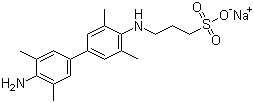 |
| Molecular Formula | C19H25N2NaO3S |
| Molecular Weight | 384.47 |
| CAS Registry Number | 102062-36-2 |
| SMILES | CC1=CC(=CC(=C1N)C)C2=CC(=C(C(=C2)C)NCCCS(=O)(=O)O)C |
| Density | 1.2±0.1 g/cm3 Calc.* |
|---|---|
| Melting point | 230-240 °C (Expl.) |
| Solubility | DMSO: 35mg/mL (Expl.) |
| Index of refraction | 1.609 (Calc.)* |
| * | Calculated using Advanced Chemistry Development (ACD/Labs) Software. |
| Hazard Symbols |  GHS07 Warning Details GHS07 Warning Details |
|---|---|
| Risk Statements | H302-H315-H319-H335 Details |
| Safety Statements | P261-P305+P351+P338 Details |
| SDS | Available |
 chemBlink Chemical Story
|
N-(3-Sulfopropyl)-3,3′,5,5′-tetramethylbenzidine sodium salt is a water-soluble, sulfonated derivative of 3,3′,5,5′-tetramethylbenzidine (TMB), a well-known chromogenic compound used extensively in biochemical and immunochemical assays. The molecule is designed to improve aqueous solubility and handling characteristics relative to the parent tetramethylbenzidine compound while retaining its redox-active aromatic core. The central structural framework is 3,3′,5,5′-tetramethylbenzidine, which consists of two benzene rings linked through a central nitrogen–nitrogen bond in a biphenyl-like arrangement. Each aromatic ring carries two methyl substituents at the 3 and 5 positions. These methyl groups increase electron density on the aromatic system and influence the compound’s redox behavior. The conjugated structure allows for electron delocalization across the two phenyl rings through the central diamine linkage. The nitrogen atoms in the benzidine core are secondary amine centers in the parent structure. In oxidation reactions, this system can form colored radical cation intermediates and quinone diimine species. These oxidized forms are responsible for the chromogenic properties of TMB derivatives in analytical applications. In N-(3-sulfopropyl)-substituted TMB, one of the nitrogen atoms is functionalized with a 3-sulfopropyl group. This substituent consists of a three-carbon alkyl chain terminating in a sulfonate group (–SO₃⁻). The sulfonate group is strongly acidic and exists in a deprotonated, negatively charged form under most conditions. In the sodium salt form, sodium cations balance this negative charge, resulting in an overall ionic compound. The introduction of the sulfopropyl group significantly increases the hydrophilicity of the molecule. The sulfonate functionality is highly polar and capable of strong interactions with water molecules through ion–dipole interactions. This modification improves solubility in aqueous buffer systems, which is important for biological assay compatibility. The sodium ion present in the salt primarily serves to balance the negative charge of the sulfonate group. In aqueous environments, the sodium ion is typically solvated and dissociated, contributing to the ionic character of the system rather than forming strong covalent interactions with the organic framework. The tetramethyl substitution pattern on the aromatic rings plays an important role in the electronic properties of the molecule. Methyl groups are electron-donating through hyperconjugation and inductive effects, increasing electron density in the aromatic system. This enhances the compound’s susceptibility to oxidation, which is central to its use as a chromogenic substrate. From a structural standpoint, the molecule is composed of a rigid aromatic core combined with a flexible aliphatic sulfonated side chain. The aromatic portion is largely planar, while the sulfopropyl substituent introduces conformational flexibility due to rotation around carbon–carbon single bonds. In solution, the compound exhibits strong polarity due to the sulfonate group, while the aromatic core retains hydrophobic character. This dual nature allows interaction with both aqueous environments and hydrophobic interfaces, although the ionic character dominates solubility behavior. Chemically, the most important reactive feature of the molecule is the redox-active benzidine-derived core. Upon oxidation, the compound can form highly conjugated intermediates that exhibit strong visible absorption, enabling its use in colorimetric detection systems. The sulfonate group is generally chemically stable and does not participate in redox transformations under typical conditions. Overall, N-(3-sulfopropyl)-3,3′,5,5′-tetramethylbenzidine sodium salt is a water-soluble, ionic derivative of a benzidine-based chromogenic compound. It combines a redox-active aromatic diamine core with a strongly hydrophilic sulfonate substituent and sodium counterion, resulting in a chemically stable, highly polar compound widely used in aqueous analytical environments. References 2026. Cellulose-Based Fiber-Optic Sensors. The Handbook of Paper-Based Sensors and Devices. DOI: 10.1007/978-3-032-02713-9_12 2015. Carotene-degrading activities from Bjerkandera adusta possess an application in detergent industries. Bioprocess and Biosystems Engineering. DOI: 10.1007/s00449-015-1361-3 |
| Market Analysis Reports |