
Online Database of Chemicals from Around the World
| Hefei TNJ Chemical Industry Co., Ltd. | China | |||
|---|---|---|---|---|
 | www.tnjchem.com | |||
 | +86 (551) 6541-8684 | |||
 | +86 (551) 6541-8697 | |||
 | sales@tnjchem.com | |||
| Chemical manufacturer since 2001 | ||||
| chemBlink Standard supplier since 2010 | ||||
| BOC Sciences | USA | |||
|---|---|---|---|---|
| www.bocsci.com | |||
| +1 (631) 485-4226 | |||
| +1 (631) 614-7828 | |||
| info@bocsci.com | |||
| Chemical manufacturer | ||||
| chemBlink Standard supplier since 2010 | ||||
| Beckmann-Kenko GmbH | Germany | |||
|---|---|---|---|---|
| www.beckmann-kenko.com | |||
| +49 (4241) 930-888 | |||
| +49 (4241) 930-889 | |||
| info@beckmann-kenko.com | |||
| Chemical distributor | ||||
| chemBlink Standard supplier since 2011 | ||||
| Kaiping Genuine Biochemical Pharmaceutical Co., Ltd. | China | |||
|---|---|---|---|---|
| www.genuine.com.cn | |||
| +86 (750) 288-1198 | |||
| +86 (750) 288-6718 | |||
| ryanli@genuine.com.cn ryanlee__yeah@hotmail.com | |||
| Chemical manufacturer since 1992 | ||||
| chemBlink Standard supplier since 2011 | ||||
| Suzhou Myland Pharm & Nutrition Inc. | China | |||
|---|---|---|---|---|
| www.mylandpharm.com | |||
| +86 (512) 6615-0687 | |||
| +86 (512) 6615-7101 | |||
| info@mylandpharm.com | |||
 | QQ Chat | |||
| Chemical manufacturer since 2013 | ||||
| chemBlink Standard supplier since 2014 | ||||
| Smartchem (Beijing) Ltd. | China | |||
|---|---|---|---|---|
| www.smartchembeijing.com | |||
| +86 (10) 5720-3829 5130-5129 +86 13301124250 | |||
| +86 (10) 5130-5388 | |||
| sales@smartchembeijing.com | |||
| QQ Chat | |||
| Chemical manufacturer since 2005 | ||||
| chemBlink Standard supplier since 2014 | ||||
| Hangzhou Leap Chem Co., Ltd. | China | |||
|---|---|---|---|---|
| www.leapchem.com | |||
| +86 (571) 8771-1850 | |||
| market19@leapchem.com | |||
| QQ Chat | |||
| Chemical manufacturer since 2006 | ||||
| chemBlink Standard supplier since 2015 | ||||
| Amadis Chemical Co., Ltd. | China | |||
|---|---|---|---|---|
| www.amadischem.com | |||
| +86 (571) 8992-5085 | |||
| +86 (571) 8992-5065 | |||
| sales@amadischem.com | |||
| Chemical manufacturer since 2010 | ||||
| chemBlink Standard supplier since 2015 | ||||
| Xi'an Yinherb Bio-tech Co., Ltd | China | |||
|---|---|---|---|---|
| yinherb.ecer.com | |||
| +86 (29) 6333-2330 | |||
| sales@yinherb-nutraceuticals.com | |||
| QQ Chat | |||
| Chemical manufacturer since 2009 | ||||
| chemBlink Standard supplier since 2021 | ||||
| HN Langyue Biotech Co Ltd | China | |||
|---|---|---|---|---|
| www.hningredients.com | |||
| +86 (731) 8639-3263 | |||
| +86 (731) 8639-3263 | |||
| hn01@hningredients.com | |||
| QQ Chat | |||
| Chemical manufacturer since 2019 | ||||
| chemBlink Standard supplier since 2021 | ||||
| Aajiang Jiuzhou Chem Co., Ltd. | China | |||
|---|---|---|---|---|
| www.jiuzhou-chem.com | |||
| +86 13454675544 | |||
| jamie@jiuzhou-chem.com | |||
| QQ Chat | |||
 | WeChat: +86 18632988332 | |||
 | WhatsApp:+86 18632988332 | |||
| Chemical manufacturer since 2007 | ||||
| chemBlink Standard supplier since 2023 | ||||
| Chemos GmbH & Co. KG | Germany | |||
|---|---|---|---|---|
| www.chemos.de | |||
| +49 871-966346-0 | |||
| +49 871-966346-13 | |||
| chemos@chemos.de | |||
| Chemical distributor | ||||
| Classification | Biochemical >> Carbohydrate >> Monosaccharide |
|---|---|
| Name | Citicoline |
| Synonyms | Cytidine 5'-diphosphate choline; Cytidine 5'-diphosphocholine; Cytidine choline diphosphate; Cytidine diphosphate choline; Cytidine diphosphate choline ester; Cytidine diphosphocholine; Cytidine diphosphorylcholine; Cytidine 5'-(trihydrogen diphosphate) P'-[2-(trimethylammonio)ethyl] ester inner salt; Cytidoline |
| Molecular Structure | 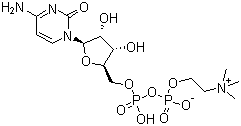 |
| Molecular Formula | C14H26N4O11P2 |
| Molecular Weight | 488.32 |
| CAS Registry Number | 987-78-0 |
| EC Number | 213-580-7 |
| SMILES | C[N+](C)(C)CCOP(=O)([O-])OP(=O)(O)OC[C@@H]1[C@H]([C@H]([C@@H](O1)N2C=CC(=NC2=O)N)O)O |
| Hazard Symbols |  GHS07 Warning Details GHS07 Warning Details | ||||||||||||||||
|---|---|---|---|---|---|---|---|---|---|---|---|---|---|---|---|---|---|
| Risk Statements | H315-H319-H335 Details | ||||||||||||||||
| Safety Statements | P261-P264-P264+P265-P271-P280-P302+P352-P304+P340-P305+P351+P338-P319-P321-P332+P317-P337+P317-P362+P364-P403+P233-P405-P501 Details | ||||||||||||||||
| Hazard Classification | |||||||||||||||||
| |||||||||||||||||
| SDS | Available | ||||||||||||||||
 chemBlink Chemical Story
|
Citicoline is an endogenous nucleotide derivative composed of cytidine and choline linked through a pyrophosphate bridge. It is also known chemically as cytidine-5′-diphosphocholine. It is a key intermediate in the biosynthesis of phosphatidylcholine, an essential phospholipid in cell membranes, particularly in neural tissue. Structurally, citicoline consists of two biologically important components: a cytidine moiety and a choline moiety. Cytidine is a nucleoside made up of the pyrimidine base cytosine attached to a ribose sugar. Choline is a quaternary ammonium alcohol containing a positively charged trimethylammonium group. These two units are connected via a diphosphate linker, forming a nucleotide-like structure. The phosphate groups are highly polar and negatively charged under physiological conditions, while the choline group carries a permanent positive charge due to its quaternary ammonium nitrogen. This results in a zwitterionic molecule with strong ionic character. The cytidine portion contributes additional polarity through hydroxyl groups on the ribose and heteroatoms in the cytosine base. Because of its multiple charged groups, citicoline is highly hydrophilic and readily soluble in water. The diphosphate linkage is central to its chemical reactivity and biological function. Phosphate esters and anhydrides in such molecules are high-energy bonds in biochemical systems and are involved in metabolic activation and transfer reactions. In biological systems, citicoline is an intermediate in the Kennedy pathway (CDP-choline pathway), which is responsible for the synthesis of phosphatidylcholine. In this pathway, citicoline is formed from cytidine triphosphate (CTP) and phosphocholine and subsequently reacts with diacylglycerol to produce phosphatidylcholine, a major structural component of cell membranes. Upon administration, citicoline can be metabolized into cytidine and choline, which are then utilized in nucleotide and phospholipid biosynthesis. Cytidine can be further converted into uridine nucleotides, while choline contributes to membrane phospholipid formation and acetylcholine synthesis. From a physicochemical perspective, citicoline is a highly polar, ionic compound with negligible lipophilicity. Its multiple charged functional groups result in strong hydration in aqueous environments and limited passive diffusion across lipid membranes. Transport across biological membranes typically involves specific transport mechanisms rather than passive diffusion. The cytosine base within citicoline can engage in hydrogen bonding interactions typical of nucleobases, including pairing-like interactions in biochemical contexts. The ribose sugar contains multiple hydroxyl groups that further increase hydrogen-bonding capacity and solubility. Chemically, citicoline is generally stable under physiological conditions but can undergo hydrolysis of phosphate bonds under strong acidic or enzymatic conditions, yielding cytidine monophosphate derivatives and free choline. These breakdown products are themselves biologically active intermediates in metabolic pathways. Overall, citicoline is a highly polar nucleotide derivative composed of cytidine and choline linked by a diphosphate bridge. Its significance lies in its central role in phosphatidylcholine biosynthesis and membrane metabolism, as well as its strongly ionic structure that governs its solubility and biochemical transport behavior. References 2026. Comparable improvements in selective, but not sustained, attention in response to a multi-ingredient nootropic formulation when compared with caffeine. European Journal of Nutrition. DOI: 10.1007/s00394-026-03926-8 2026. Assessment of phenotypic trait plasticity in the oilseed Camelina sativa using integrated early stage abiotic stress and field studies. Plant Physiology. DOI: https://www.ncbi.nlm.nih.gov/pmc/articles/PMC13017834 |
| Market Analysis Reports |