
Online Database of Chemicals from Around the World
| Pharmaccare | UK | |||
|---|---|---|---|---|
 | www.pharmaccare.com | |||
 | +44 7362050789 | |||
 | duranjohnson16@gmail.com | |||
| Chemical distributor since 2020 | ||||
| chemBlink Standard supplier since 2026 | ||||
| Classification | Organic raw materials >> Heterocyclic compound >> Imidazoles |
|---|---|
| Name | Protonitazene |
| Synonyms | N,N-diethyl-2-[5-nitro-2-[(4-propoxyphenyl)methyl]benzimidazol-1-yl]ethanamine |
| Molecular Structure | 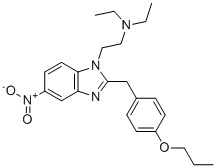 |
| Molecular Formula | C23H30N4O3 |
| Molecular Weight | 410.51 |
| CAS Registry Number | 95958-84-2 |
| SMILES | CCCOC1=CC=C(C=C1)CC2=NC3=C(N2CCN(CC)CC)C=CC(=C3)[N+](=O)[O-] |
| Density | 1.2±0.1 g/cm3 Calc.* |
|---|---|
| Boiling point | 589.7±45.0 °C 760 mmHg (Calc.)* |
| Flash point | 310.4±28.7 °C (Calc.)* |
| Index of refraction | 1.586 (Calc.)* |
| * | Calculated using Advanced Chemistry Development (ACD/Labs) Software. |
| Hazard Symbols |  GHS07 Warning Details |
|---|---|
| Risk Statements | H302-H312-H332 Details |
| Safety Statements | P261-P264-P280-P301+P312-P302+P352-P304+P340-P321-P330-P362+P364 Details |
| SDS | Available |
 chemBlink Chemical Story
|
Two molecules can have the same formula yet require separate identification. Protonitazene, CAS 95958-84-2, makes this issue important in forensic toxicology. It belongs to the 2-benzylbenzimidazole synthetic-opioid family commonly called nitazenes. Its aromatic substituent contains a normal-propoxy group, distinguishing it from the branched isopropoxy group in isotonitazene. Rearranging those atoms preserves the formula while changing the structure. This entry identifies the free base. A hydrochloride reference material is a different supplied form with a different CAS identity and composition. The distinction matters for preparing or interpreting an analytical standard, even when the measured ion corresponds primarily to the organic part of the molecule. Substance names, salt specifications, and the analytical species being measured should remain consistent with one another. Protonitazene's opioid activity makes exact identification more than a naming exercise. The World Health Organization reviewed the substance in 2022 in the context of dependence and public-health concerns. The review places it within the history of benzimidazole opioid research and its later appearance outside an established therapeutic application. That context supports analytical and toxicological investigation, rather than treating structural similarity to another opioid as sufficient evidence about its effects. The isomer problem provides a practical illustration. A 2023 Journal of Analytical Toxicology study developed a method for several nitazenes in whole blood and achieved chromatographic separation of protonitazene and isotonitazene before tandem mass-spectrometric detection. Separation adds information that nominal mass alone cannot provide. The method demonstrates why chemically related compounds need to be distinguished within the actual sample matrix. An analytical result also needs a clinical context when it is used to investigate an intoxication. In 2024, Syrjanen and colleagues reported two cases of opioid toxicity following use of products represented as tetrahydrocannabinol vapes, with protonitazene detected. Such cases show why the expected identity of a product may not describe its actual contents. The report is evidence about those investigated cases, not a statement that all products in the category contain the same substance. Laboratory sensitivity and interpretive restraint are complementary. A method must detect a relevant substance reliably, but a concentration or receptor comparison does not automatically determine the contribution of every component in a mixture. Sample timing, other substances, and the available clinical information influence the conclusions that can be drawn. In particular, laboratory potency comparisons should not be converted into claims about safe human exposure. An isomer pair is a particularly strong test of analytical specificity. Matching an elemental composition narrows the possibilities, but it does not show which arrangement of those elements is present. When related structures produce similar fragments, the time at which each emerges from a chromatographic separation can provide an additional distinguishing dimension. That dimension must be demonstrated with suitable comparisons rather than assumed from a database formula. This connects molecular structure with laboratory communication. Reporting a family-level finding and reporting one identified member are different levels of certainty. Clear wording helps a reader understand whether an observation concerns a broad class, an unresolved isomer pair, or an individual compound. Such distinctions are useful when results are compared across laboratories and when a newly encountered substance is added to an existing screening method. Protonitazene's story therefore connects molecular isomerism with analytical preparedness and public-health monitoring. A small difference in an alkoxy group can make a distinct target for identification. A reliable account follows the exact structure, the material form, and the evidence from actual samples, rather than relying on a family nickname or assuming that one analytical signal tells the whole story. References: 1. WHO Expert Committee on Drug Dependence. Critical Review Report: Protonitazene. 45th meeting, 2022; free-base CAS 95958-84-2. https://cdn.who.int/media/docs/default-source/controlled-substances/45th-ecdd/protonitazene_draft.pdf 2. High-throughput quantification of emerging nitazene benzimidazole opioid analogs by microextraction and UHPLC-MS-MS. J Anal Toxicol. 2023;47:787. https://pubmed.ncbi.nlm.nih.gov/37700512/ 3. Syrjanen R et al. Protonitazene detection in two cases of opioid toxicity following the use of tetrahydrocannabinol vape products in Australia. Clin Toxicol. 2024;62:539-541. https://doi.org/10.1080/15563650.2024.2383692 |
| Market Analysis Reports |