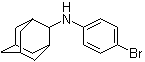
Bromantan, also called bromantane, has a rigid hydrocarbon cage at one end and a brominated aromatic ring at the other. The cage is adamantane, a ten-carbon framework often compared to a tiny fragment of the diamond lattice. An amine nitrogen connects position 2 of that cage to a phenyl group. Bromine lies opposite the nitrogen attachment on the ring, the position described as para. In drawings, attention tends to go to the bromine and the cage. For identity, the location of their connections is just as important.
Bromine also leaves a fingerprint in a mass spectrum. Natural bromine contains two abundant isotopes with masses about two units apart. When a fragment retains a single bromine atom and carries a single charge, the corresponding signals can appear as a pair roughly two mass-to-charge units apart and of similar intensity. A fragment without bromine does not carry that pattern. The pair gives a clue to elemental composition; on its own it does not locate the atom on the aromatic ring or distinguish bromantan from other brominated compounds. Reference spectra and separation supply additional evidence.
The compound entered the anti-doping literature in the 1990s. Burnat and colleagues published a report under the spelling bromontan in 1997. The World Anti-Doping Agency's 2026 list uses bromantan and includes it among non-specified stimulants prohibited in competition. This describes an anti-doping classification rather than a classification under national prescription-drug laws. Different spellings in these documents are a reason to check the structure or registry number when following the literature.
For forensic chemistry, the compound links structural interpretation to a concrete identification problem. An analyst cannot infer identity from a regulatory category, because chemically unrelated substances can appear in that same category. The chemical name specifies the cage position, the nitrogen link and the substituted ring. The laboratory then needs observations capable of supporting that assignment in a real sample. The combination of a distinctive isotope signature and a defined reference structure makes bromantan a particularly clear example of why a suggestive signal is useful but not conclusive.
References:
1. PubChem, Bromantan, CID 4660557. https://pubchem.ncbi.nlm.nih.gov/compound/4660557
2. Burnat P et al. Bromontan, a new doping agent. 1997. https://pubmed.ncbi.nlm.nih.gov/9314900/
3. World Anti-Doping Agency. 2026 Prohibited List, section S6. https://www.wada-ama.org/sites/default/files/2025-09/2026list_en_final_clean_september_2025.pdf
|




 GHS07 Warning Details
 chemBlink Chemical Story