
Online Database of Chemicals from Around the World
| Simagchem Corporation | China | |||
|---|---|---|---|---|
 | www.simagchem.com | |||
 | +86 13806087780 | |||
 | +86 (592) 268-0237 | |||
 | sale@simagchem.com | |||
| Chemical manufacturer since 2002 | ||||
| chemBlink Standard supplier since 2008 | ||||
| Reddy N Reddy Pharmaceuticals | India | |||
|---|---|---|---|---|
| www.reddynreddypharma.com | |||
| +91 (40) 2307-5686 +91 98480-96759 +91 98481-96759 | |||
| info@reddynreddypharma.com | |||
| Chemical manufacturer | ||||
| chemBlink Standard supplier since 2010 | ||||
| BOC Sciences | USA | |||
|---|---|---|---|---|
| www.bocsci.com | |||
| +1 (631) 485-4226 | |||
| +1 (631) 614-7828 | |||
| info@bocsci.com | |||
| Chemical manufacturer | ||||
| chemBlink Standard supplier since 2010 | ||||
| Infinity Scientific | China | |||
|---|---|---|---|---|
| www.infsci.com | |||
| +86 400-106-2016 +86 18500163824 | |||
| biz2@infsci.com | |||
 | QQ Chat | |||
| Chemical manufacturer since 2014 | ||||
| chemBlink Standard supplier since 2015 | ||||
| Hangzhou Leap Chem Co., Ltd. | China | |||
|---|---|---|---|---|
| www.leapchem.com | |||
| +86 (571) 8771-1850 | |||
| market19@leapchem.com | |||
| QQ Chat | |||
| Chemical manufacturer since 2006 | ||||
| chemBlink Standard supplier since 2015 | ||||
| Carbosynth China Ltd. | China | |||
|---|---|---|---|---|
| www.carbosynth.cn | |||
| +86 (512) 6260-5585 | |||
| +86 (512) 6260-5576 | |||
| sales@carbosynth.com | |||
| QQ Chat | |||
| Chemical manufacturer since 2006 | ||||
| chemBlink Standard supplier since 2016 | ||||
| Nanjing Qiangshan New Material Co., Ltd. | China | |||
|---|---|---|---|---|
| www.njqschem.com | |||
| +86 (25) 5702-7223 | |||
| dols80@163.com | |||
| Chemical distributor since 2011 | ||||
| chemBlink Standard supplier since 2020 | ||||
| INA Pharmaceuticals Pvt. Ltd. | India | |||
|---|---|---|---|---|
| inapharma.in | |||
| +91 7815933367 | |||
| rd@inapharma.in | |||
| Chemical manufacturer since 2018 | ||||
| chemBlink Standard supplier since 2026 | ||||
| Anvia Chemicals, LLC | USA | |||
|---|---|---|---|---|
| www.anviachem.com | |||
| +1 (414) 534-7845 | |||
| +1 (414) 762-5539 | |||
| sales@anviachem.com | |||
| Chemical manufacturer | ||||
| Organo Fine Chemicals | India | |||
|---|---|---|---|---|
| www.organo.in | |||
| +91 (22) 2201-6968 2206-7521 | |||
| +91 (22) 2205-9299 / 2208-3184 | |||
| info@organo.in | |||
| Chemical manufacturer | ||||
| Activate Scientific GmbH | Germany | |||
|---|---|---|---|---|
| www.activate-scientific.com | |||
| +49 (8051) 965-1660 | |||
| +49 (8051) 965-1661 | |||
| rschmitt@activate-scientific.com | |||
| Chemical manufacturer | ||||
| Frontier Scientific Services, Inc. | USA | |||
|---|---|---|---|---|
| www.frontierssi.com | |||
| +1 (302) 266-6891 (888) 577-2734 | |||
| +1 (302) 266-8296 | |||
| customerservice@frontierssi.com | |||
| Chemical manufacturer | ||||
| Classification | Chemical reagent >> Organic reagent >> Aromatic hydrocarbon reagent |
|---|---|
| Name | 4-Methoxybenzylchloride |
| Synonyms | 4-(Chloromethyl)anisole; 1-Chloromethyl-4-methoxybenzene |
| Molecular Structure | 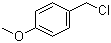 |
| Molecular Formula | C8H9ClO |
| Molecular Weight | 156.61 |
| CAS Registry Number | 824-94-2 |
| EC Number | 212-540-6 |
| SMILES | COC1=CC=C(C=C1)CCl |
| Density | 1.1±0.1 g/cm3 Calc.*, 1.155 g/mL (Expl.) |
|---|---|
| Melting point | -1 °C (Expl.) |
| Boiling point | 243.6 °C 760 mmHg (Calc.)*, 262.8 - 264.2 °C (Expl.) |
| Flash point | 109.4 °C (Calc.)*, 109 °C (Expl.) |
| Solubility | water: slowly decomposes (Expl.) |
| Index of refraction | 1.517 (Calc.)*, 1.548 (Expl.) |
| * | Calculated using Advanced Chemistry Development (ACD/Labs) Software. |
| Hazard Symbols |  GHS05 Danger Details GHS05 Danger Details | ||||||||||||||||||||||||
|---|---|---|---|---|---|---|---|---|---|---|---|---|---|---|---|---|---|---|---|---|---|---|---|---|---|
| Risk Statements | H314 Details | ||||||||||||||||||||||||
| Safety Statements | P260-P264-P280-P301+P330+P331-P302+P361+P354-P304+P340-P305+P354+P338-P316-P321-P363-P405-P501 Details | ||||||||||||||||||||||||
| Hazard Classification | |||||||||||||||||||||||||
| |||||||||||||||||||||||||
| Transport Information | UN 3265 | ||||||||||||||||||||||||
| SDS | Available | ||||||||||||||||||||||||
 chemBlink Chemical Story
|
4-Methoxybenzyl chloride, CAS 824-94-2, is an aromatic alkyl chloride widely used as an alkylating reagent and as a source of the p-methoxybenzyl protecting group in organic synthesis. It is also known as p-methoxybenzyl chloride, PMB chloride, or 4-(chloromethyl)anisole. Its molecular formula is C8H9ClO and its molecular weight is 156.61. Structurally, the molecule consists of an anisole ring bearing a chloromethyl group para to the methoxy substituent. Its most important synthetic feature is the benzylic C-Cl bond. Chloride can leave when an oxygen, nitrogen, sulfur, or other nucleophile attacks the benzylic carbon. The entire p-methoxybenzyl fragment can therefore be transferred to another molecule. A particularly important application is protection of alcohols and phenols. Suppose a molecule contains an -OH group that will be needed later but is likely to interfere with several intermediate reactions. A chemist can temporarily convert it into a p-methoxybenzyl ether: R-OH → R-O-CH2-C6H4-OCH3 The oxygen remains in the molecule, but it is no longer present as a free hydroxyl group. This is protecting-group chemistry: temporarily alter the reactivity of one functional group, perform chemistry elsewhere, and reveal the original functionality again when it is needed. At first sight, a p-methoxybenzyl ether looks very similar to an ordinary benzyl ether. The difference is only one methoxy group at the para position of the aromatic ring. Chemically, however, that methoxy group is extremely useful. It donates electron density into the aromatic ring and stabilizes electron-deficient intermediates associated with oxidative cleavage of the benzylic C-O bond. Consequently, p-methoxybenzyl ethers can often be removed under oxidative conditions that leave ordinary benzyl ethers intact. One of the most familiar reagents for this purpose is 2,3-dichloro-5,6-dicyano-1,4-benzoquinone, commonly abbreviated DDQ. This difference creates the possibility of orthogonal protection. Imagine a molecule containing two different alcohols. One is protected as a benzyl ether. The other is protected as a p-methoxybenzyl ether. At a later stage, the chemist may want to expose only the second alcohol. Under suitable oxidative conditions, the PMB group can be removed while the ordinary benzyl group remains. The molecule therefore contains two hydroxyl groups that can be uncovered at different times. This is a powerful idea in multistep synthesis. Protecting groups are not merely covers placed over reactive sites. Different protecting groups can function as chemically distinguishable switches. One switch responds to one set of conditions. Another responds to something else. The chemist can decide which functional group becomes available at each stage of a synthesis. The usefulness of 4-methoxybenzyl chloride for installing this protecting group is well documented. A 2008 study reported an efficient method for preparing and using PMB chloride for protection of phenolic hydroxyl groups. Power ultrasound accelerated both preparation of the reagent and subsequent formation of protected phenolic ethers. The researchers demonstrated that freshly prepared 4-methoxybenzyl chloride could be used rapidly with a range of phenols to form the corresponding PMB ethers in good yields. The study illustrates an important practical aspect of protecting-group chemistry. A protecting group is useful only if it can be installed conveniently as well as removed selectively. PMB became popular because it offers both useful stability during synthesis and several practical routes for later cleavage. Alcohols are not the only functional groups that can use the p-methoxybenzyl framework. PMB-derived protection has been used for phenols, carboxylic acids, nitrogen-containing compounds, and other heteroatom functionalities, depending on the specific substrate and reaction conditions. For carboxylic acids, for example, reaction with a p-methoxybenzylating reagent can form a p-methoxybenzyl ester. The acid is temporarily masked as an ester and can later be regenerated. The relationship between PMB and ordinary benzyl protection also illustrates how surprisingly small structural changes can alter synthetic behavior. Both groups contain the same benzylic CH2 connection. Both carry an aromatic ring. But PMB adds just one OCH3 group. That small electronic modification provides an additional route for selective deprotection. This has made PMB particularly valuable in total synthesis of complex natural products. Such molecules may contain several hydroxyl groups, double bonds, carbonyls, rings, and stereogenic centers, and different functional groups often have to be exposed at carefully chosen stages. Published total syntheses repeatedly use DDQ to remove PMB ethers after much of the molecular skeleton has already been constructed. In some cases, a benzyl ether or other protecting group remains intact during the PMB deprotection. The PMB group therefore illustrates the concept of chemical timing. An alcohol may be important in the final molecule. But during an earlier step, the chemist needs it to remain silent. The PMB group tells that hydroxyl group: not yet. Later, oxidative deprotection tells it: now. 4-Methoxybenzyl chloride is the reagent that can install this temporary instruction. The molecule itself is small, but the synthetic idea behind it is sophisticated. Its chlorine provides a point of attachment, while the para-methoxybenzyl fragment supplies a protecting group whose electronic structure makes selective removal possible. In multistep synthesis, the challenge is not simply to know which functional groups can react. It is to control the order in which they are allowed to react. 4-Methoxybenzyl chloride became a widely used reagent because it helps chemists control exactly that. References 1. Luzzio, F. A.; Chen, J. (2008). "Efficient Preparation and Processing of the 4-Methoxybenzyl (PMB) Group for Phenolic Protection Using Ultrasound." The Journal of Organic Chemistry, 73, 5621-5624. 2. Horita, K.; Yoshioka, T.; Tanaka, T.; Oikawa, Y.; Yonemitsu, O. Studies of selective oxidative removal of methoxybenzyl protecting groups with DDQ. 3. Wuts, P. G. M. Greene's Protective Groups in Organic Synthesis. Chemistry of benzyl and p-methoxybenzyl protecting groups. 4. Sigma-Aldrich. 4-Methoxybenzyl chloride, CAS 824-94-2. Chemical identity and synthetic applications. 5. Published total-synthesis studies employing selective DDQ removal of PMB ethers in the presence of other protecting groups. |
| Market Analysis Reports |