
Online Database of Chemicals from Around the World
| Cangzhou Goldlion Chemicals Co., Ltd. | China | |||
|---|---|---|---|---|
 | www.goldlionchem.com | |||
 | +86 13315721466 +86 (317) 530-4268 | |||
 | +86 (317) 530-4268 | |||
 | info@goldlionchem.com | |||
| Chemical manufacturer | ||||
| chemBlink Standard supplier since 2007 | ||||
| Simagchem Corporation | China | |||
|---|---|---|---|---|
| www.simagchem.com | |||
| +86 13806087780 | |||
| +86 (592) 268-0237 | |||
| sale@simagchem.com | |||
| Chemical manufacturer since 2002 | ||||
| chemBlink Standard supplier since 2008 | ||||
| Lianyungang United Chemical Co., Ltd. | China | |||
|---|---|---|---|---|
| www.lyg-china.com | |||
| +86 (518) 8569-2709 | |||
| +86 (518) 8501-5182 | |||
| service@lyg-china.com | |||
| Chemical manufacturer since 2004 | ||||
| chemBlink Standard supplier since 2008 | ||||
| Nile Chemicals | India | |||
|---|---|---|---|---|
| www.nilechemicals.com | |||
| +91 (22) 6631-3162 | |||
| +91 (22) 2205-4833 | |||
| sales@nilechemicals.com | |||
| Chemical manufacturer | ||||
| chemBlink Standard supplier since 2009 | ||||
| Hefei TNJ Chemical Industry Co., Ltd. | China | |||
|---|---|---|---|---|
| www.tnjchem.com | |||
| +86 (551) 6541-8684 | |||
| +86 (551) 6541-8697 | |||
| sales@tnjchem.com | |||
| Chemical manufacturer since 2001 | ||||
| chemBlink Standard supplier since 2010 | ||||
| BOC Sciences | USA | |||
|---|---|---|---|---|
| www.bocsci.com | |||
| +1 (631) 485-4226 | |||
| +1 (631) 614-7828 | |||
| info@bocsci.com | |||
| Chemical manufacturer | ||||
| chemBlink Standard supplier since 2010 | ||||
| Hangzhou Leap Chem Co., Ltd. | China | |||
|---|---|---|---|---|
| www.leapchem.com | |||
| +86 (571) 8771-1850 | |||
| market19@leapchem.com | |||
 | QQ Chat | |||
| Chemical manufacturer since 2006 | ||||
| chemBlink Standard supplier since 2015 | ||||
| Anhui Royal Chemical Co., Ltd. | China | |||
|---|---|---|---|---|
| www.royal-chem.com | |||
| +86 (25) 8663-9253 | |||
| +86 (25) 5227-9193 | |||
| zoey.zhao@royal-chem.com | |||
| Chemical manufacturer since 2008 | ||||
| chemBlink Standard supplier since 2019 | ||||
| Neostar United (Changzhou) Industrial Co., Ltd. | China | |||
|---|---|---|---|---|
| www.neostarunited.com | |||
| +86 (519) 8555-7386 +86 18015025600 | |||
| +86 (519) 8555-7389 | |||
| marketing1@neostarunited.com | |||
| Chemical distributor since 2014 | ||||
| chemBlink Standard supplier since 2020 | ||||
| Mudanjiang Fengda Chemicals Import and Export Co., Ltd. | China | |||
|---|---|---|---|---|
| www.mudanjiangchem.com | |||
| +86 (453) 625-5887 | |||
| +86 (453) 629-6887 / 622-3551 | |||
| fengda@mudanjiangchem.com | |||
 | WeChat: fengdachem | |||
 | WhatsApp:+8615645398875 | |||
| Chemical distributor since 1995 | ||||
| chemBlink Standard supplier since 2026 | ||||
| ChemPur GmbH | Germany | |||
|---|---|---|---|---|
| www.chempur.de | |||
| +49 (721) 933-840 | |||
| +49 (721) 47-2001 | |||
| info@chempur.de | |||
| Chemical manufacturer | ||||
| ProChem, Inc. | USA | |||
|---|---|---|---|---|
| www.prochemonline.com | |||
| +1 (815) 398-1788 | |||
| +1 (815) 398-1810 | |||
| prochem3@aol.com | |||
| Chemical manufacturer since 1986 | ||||
| Punjab Chemicals & Crop Protection Limited | India | |||
|---|---|---|---|---|
| www.punjabchemicals.com | |||
| +91 (22) 2674-7900 | |||
| +91 (22) 2673-6193 / 2673-6178 | |||
| pharmainfo@punjabchemicals.com | |||
| Chemical manufacturer since 1975 | ||||
| Chemos GmbH & Co. KG | Germany | |||
|---|---|---|---|---|
| www.chemos.de | |||
| +49 871-966346-0 | |||
| +49 871-966346-13 | |||
| chemos@chemos.de | |||
| Chemical distributor | ||||
| Santa Cruz Biotechnology, Inc. | USA | |||
|---|---|---|---|---|
| www.scbt.com | |||
| +1 (831) 457-3800 | |||
| +1 (831) 457-3801 | |||
| scbt@scbt.com | |||
| Chemical manufacturer | ||||
| Boya (Tianjin) International Limited | China | |||
|---|---|---|---|---|
| www.boya-chemical.com | |||
| +86 (22) 2430-2708 2430-2718 | |||
| +86 (22) 2430-2728 / 2430-2738 | |||
| boya.chemical@163.com | |||
| Chemical distributor | ||||
| Avonchem/Chromos Express Ltd. | UK | |||
|---|---|---|---|---|
| www.avonchem.co.uk | |||
| +44 (1625) 434-300 | |||
| +44 (1625) 869-777 | |||
| info@avonchem.co.uk | |||
| Chemical manufacturer | ||||
| Classification | Organic raw materials >> Carboxylic compounds and derivatives >> Acyclic carboxylic acid |
|---|---|
| Name | Oxalic acid dihydrate |
| Synonyms | Ethanedionic acid |
| Molecular Structure | 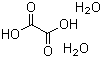 |
| Molecular Formula | C2H2O4.2(H2O) |
| Molecular Weight | 126.06 |
| CAS Registry Number | 6153-56-6 |
| EC Number | 612-167-2 |
| SMILES | C(=O)(C(=O)O)O.O.O |
| Melting point | 98-102 °C (dec) |
|---|---|
| Sublimation | 157 °C |
| Water solubility | 138 g/L (20 °C) |
| Hazard Symbols |    GHS05;GHS07;GHS08 Danger Details GHS05;GHS07;GHS08 Danger Details | ||||||||||||||||||||||||||||
|---|---|---|---|---|---|---|---|---|---|---|---|---|---|---|---|---|---|---|---|---|---|---|---|---|---|---|---|---|---|
| Risk Statements | H302+H312-H302-H312-H315-H318-H373 Details | ||||||||||||||||||||||||||||
| Safety Statements | P260-P264-P264+P265-P270-P280-P301+P317-P302+P352-P305+P354+P338-P317-P319-P321-P330-P332+P317-P362+P364-P501 Details | ||||||||||||||||||||||||||||
| Hazard Classification | |||||||||||||||||||||||||||||
| |||||||||||||||||||||||||||||
| Transport Information | UN 1759 | ||||||||||||||||||||||||||||
| SDS | Available | ||||||||||||||||||||||||||||
 chemBlink Chemical Story
|
Oxalic acid dihydrate, CAS 6153-56-6, is the crystalline dihydrate of oxalic acid, the simplest dicarboxylic acid. Its formula is H2C2O4·2H2O and its molecular weight is approximately 126.07. The two water molecules are part of the crystalline hydrate rather than merely moisture on the surface. This apparently simple compound connects several surprisingly different areas of chemistry: classical quantitative analysis, metal cleaning, plant chemistry, and the formation of calcium oxalate crystals. Oxalic acid contains only two carbon atoms, and both belong to carboxyl groups. It can lose two protons in successive acid-base equilibria, ultimately producing the oxalate ion, C2O42−. Oxalate is more than simply the conjugate base of an acid. Its two carboxylate groups allow it to interact strongly with many metal ions, and this ability explains much of the compound's practical and biological chemistry. One of the oldest laboratory roles of oxalic acid dihydrate is in volumetric analysis. A primary standard must be available in sufficiently pure and stable form so that an accurately weighed amount corresponds reliably to a known number of moles. Crystalline oxalic acid dihydrate has historically been used for preparing and standardizing solutions in acid-base and oxidation-reduction analysis. Its accurately defined hydrate composition is important here: the two waters must be included when converting mass into moles. The Royal Society of Chemistry, for example, lists H2C2O4·2H2O among examples of primary standards used in volumetric analysis. This is an interesting case in which having water in a crystal does not automatically make a substance unsuitable for accurate analytical work. What matters is whether the hydrate has a reproducible, sufficiently stable composition. Oxalate also participates in a classic oxidation-reduction reaction with permanganate in acidic solution. Permanganate's intense purple color disappears as Mn(VII) is reduced while oxalate is oxidized to carbon dioxide. In simplified ionic form: 2 MnO4− + 5 C2O42− + 16 H+ → 2 Mn2+ + 10 CO2 + 8 H2O The reaction became part of classical analytical chemistry, although accurate permanganate standardization requires attention to acidity, temperature, reaction rate, and experimental procedure. It is a good reminder that even a balanced equation does not by itself guarantee an accurate analytical method. Outside the analytical laboratory, oxalic acid is well known for its interaction with metals. Oxalate can coordinate metal ions, and acidic oxalate solutions can help dissolve or mobilize certain metal-containing deposits. This contributes to the use of oxalic acid in cleaning, bleaching, and rust-removal applications. Iron oxide stains that are difficult to remove with ordinary washing can be attacked because acid assists dissolution while oxalate interacts with dissolved iron species. The same metal-binding chemistry has a very different consequence when the metal is calcium. Calcium oxalate is poorly soluble: Ca2+ + C2O42− → CaC2O4↓ This simple precipitation reaction connects oxalic acid chemistry to both plants and human physiology. Oxalate occurs naturally in many plants. Spinach, rhubarb, beet leaves, and several other foods can contain appreciable amounts. Plants can accumulate calcium oxalate as microscopic crystals with characteristic shapes. Depending on the plant, these crystals may occur as needles, clusters, prisms, or other forms. They can participate in calcium regulation and defense, and in some species sharp calcium oxalate crystals contribute to irritation when plant tissue is eaten or handled. The same insoluble salt is important in medicine because calcium oxalate is the principal mineral component of many kidney stones. Human oxalate can come from food and can also be produced metabolically. When urine becomes sufficiently supersaturated with calcium and oxalate, crystals may nucleate, grow, aggregate, and under suitable conditions contribute to stone formation. This does not mean that simply eating a food containing oxalate automatically produces a kidney stone. Stone formation depends on urine volume, calcium and oxalate concentrations, citrate, pH, diet, intestinal absorption, metabolism, and individual physiological factors. The important chemical point is narrower and more fundamental: Ca2+ and oxalate have a strong tendency to form a sparingly soluble solid. That same reaction can even begin before oxalate reaches the kidneys. Calcium and oxalate can interact in the digestive tract, and calcium oxalate formed there may be poorly absorbed. This is one reason the relationship between dietary calcium and oxalate is more complicated than the simple assumption that "less calcium must always mean fewer calcium stones." Oxalic acid dihydrate therefore has an unusual double identity. In the analytical laboratory, its well-defined crystalline composition allows chemists to weigh matter with precision and relate grams to moles. In natural systems, the oxalate derived from the same small two-carbon acid interacts strongly with metal ions and can become part of mineral crystals. The contrast is striking. A chemist may carefully weigh colorless oxalic acid dihydrate crystals to establish the concentration of a solution. A plant may deposit calcium oxalate crystals inside its cells. A kidney stone may grow from calcium oxalate crystals in urine. These situations look completely unrelated, yet all are governed by the same small oxalate unit. Few compounds demonstrate more clearly how basic chemical principles travel between the laboratory and the living world. Acid-base equilibria determine which oxalate species are present; oxidation-reduction chemistry allows oxalate to react with permanganate; coordination chemistry explains its affinity for metals; and solubility equilibria determine when calcium oxalate becomes a solid. Two carbon atoms are enough to connect a titration flask, a rusty surface, a spinach leaf, and a kidney stone. References 1. PubChem. Oxalic Acid Dihydrate, CID 61373, CAS 6153-56-6. Formula, molecular weight, identifiers, properties, and biological information. 2. Royal Society of Chemistry Education. Prepare oxalic acid as a primary standard. Volumetric analysis and primary-standard applications of oxalic acid dihydrate. 3. Fowler, R. M.; Bright, H. A. (1935). "Standardization of Permanganate Solutions with Sodium Oxalate." Journal of Research of the National Bureau of Standards, 15, 493-500. 4. Published botanical literature on calcium oxalate crystal formation and function in plants. 5. Published clinical and biochemical literature on calcium oxalate crystallization and kidney-stone formation. |
| Market Analysis Reports |