
Online Database of Chemicals from Around the World
| Wuhan Kemi-works Chemical Co., Ltd. | China | |||
|---|---|---|---|---|
 | www.kemiworks.net | |||
 | +86 (27) 8573-6489 | |||
 | +86 (27) 8573-6485 | |||
 | info@kemiworks.net sales@kemiworks.com | |||
| Chemical manufacturer | ||||
| chemBlink Premium supplier since 2011 | ||||
| Classification | Organic raw materials >> Carboxylic compounds and derivatives >> Carboxylic esters and their derivatives |
|---|---|
| Name | Neopentylglycol dibenzoate |
| Synonyms | (3-benzoyloxy-2,2-dimethylpropyl) benzoate |
| Molecular Structure | 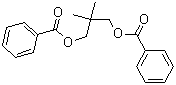 |
| Molecular Formula | C19H20O4 |
| Molecular Weight | 312.36 |
| CAS Registry Number | 4196-89-8 |
| EC Number | 224-081-9 |
| SMILES | CC(C)(COC(=O)C1=CC=CC=C1)COC(=O)C2=CC=CC=C2 |
| Density | 1.1±0.1 g/cm3 Calc.* |
|---|---|
| Melting point | 49 °C (Expl.) |
| Boiling point | 436.2±28.0 °C 760 mmHg (Calc.)* |
| Flash point | 215.8±22.4 °C (Calc.)* |
| Index of refraction | 1.55 (Calc.)* |
| * | Calculated using Advanced Chemistry Development (ACD/Labs) Software. |
| Hazard Symbols |  GHS07 Warning Details GHS07 Warning Details |
|---|---|
| Risk Statements | H302-H315-H319-H335 Details |
| Safety Statements | P261-P280-P301+P312-P302+P352-P305+P351+P338 Details |
| SDS | Available |
 chemBlink Chemical Story
|
Neopentyl glycol dibenzoate is an aromatic diester formed by esterification of both hydroxyl groups of neopentyl glycol with benzoic acid. It belongs to the benzoate ester family and is widely used as a specialty plasticizer and formulation additive in polymers, coatings, adhesives, sealants, and related materials systems. Structurally, the molecule consists of three major features: a central neopentyl glycol core, two ester linkages, and two benzoate (phenyl–carboxylate) groups. The neopentyl glycol portion contains a branched carbon framework with a quaternary carbon center, while the benzoate groups provide aromatic character and increase hydrophobicity. A notable characteristic of neopentyl glycol derivatives is their steric structure. The branched neopentyl arrangement creates steric shielding around adjacent bonds, which often increases resistance to hydrolysis and oxidative degradation compared with less hindered esters. This contributes to enhanced stability in industrial applications. The ester carbonyl groups are the most polarized regions of the molecule. Like other esters, these groups can undergo hydrolysis under strongly acidic or strongly basic conditions, ultimately yielding benzoic acid and neopentyl glycol. Under ordinary use conditions, however, the compound is generally stable. From a materials chemistry perspective, neopentyl glycol dibenzoate is valuable because of its plasticizing properties. Plasticizers function by reducing intermolecular attractions between polymer chains, increasing chain mobility and improving flexibility and processing behavior. Incorporation into polymer systems can lower glass-transition temperatures and improve mechanical properties. Compared with smaller plasticizers, the relatively large aromatic ester structure often provides lower volatility and reduced migration. These characteristics can improve long-term performance in materials where retention of flexibility is important. Physicochemically, neopentyl glycol dibenzoate is expected to exhibit: * Low water solubility due to its large hydrophobic aromatic content * Good compatibility with many organic resins and polymer systems * Moderate polarity arising from ester oxygen atoms * Relatively low volatility compared with lower molecular weight esters The aromatic benzoate groups increase molecular weight and compatibility with certain polymer matrices, while the branched neopentyl core contributes flexibility and stability. This combination makes the compound useful in adhesives, latex formulations, coatings, PVC systems, and other industrial materials applications. Overall, neopentyl glycol dibenzoate is a branched aromatic diester whose significance lies primarily in materials science as a stable, relatively low-volatility plasticizer that combines good polymer compatibility with enhanced resistance to degradation. References 2011. N. Encyclopedic Dictionary of Polymers. DOI: 10.1007/978-1-4419-6247-8_7760 2007. n. Encyclopedic Dictionary of Polymers. DOI: 10.1007/978-0-387-30160-0_7627 |
| Market Analysis Reports |