
Online Database of Chemicals from Around the World
| BOC Sciences | USA | |||
|---|---|---|---|---|
 | www.bocsci.com | |||
 | +1 (631) 485-4226 | |||
 | +1 (631) 614-7828 | |||
 | info@bocsci.com | |||
| Chemical manufacturer | ||||
| chemBlink Standard supplier since 2010 | ||||
| Alfa Chemistry | USA | |||
|---|---|---|---|---|
| www.alfa-chemistry.com | |||
| +1 (516) 734-6573 | |||
| +1 (516) 927-0118 | |||
| support@alfa-chemistry.com | |||
| Chemical manufacturer since 2005 | ||||
| chemBlink Standard supplier since 2012 | ||||
| Ningbo Kilo Biotechnology Co., Ltd. | China | |||
|---|---|---|---|---|
| www.kilobio.com | |||
| +8613989352104 | |||
| terry.zhang@kilobio.com | |||
 | QQ Chat | |||
 | WeChat: Wenzhou Medical University | |||
| Chemical distributor since 2023 | ||||
| chemBlink Standard supplier since 2023 | ||||
| Classification | API >> Digestive system medication |
|---|---|
| Name | Larazotide |
| Synonyms | Glycylglycyl-L-valyl-L-leucyl-L-valyl-L-glutaminyl-L-prolylglycine |
| Molecular Structure | 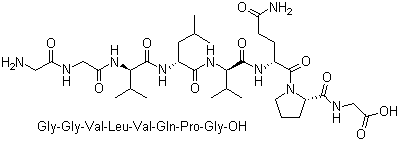 |
| Molecular Formula | C32H55N9O10 |
| Molecular Weight | 725.83 |
| Protein Sequence | GGVLVQPG |
| CAS Registry Number | 258818-34-7 |
| SMILES | CC(C)C[C@@H](C(=O)N[C@@H](C(C)C)C(=O)N[C@@H](CCC(=O)N)C(=O)N1CCC[C@H]1C(=O)NCC(=O)O)NC(=O)[C@H](C(C)C)NC(=O)CNC(=O)CN |
| Density | 1.3±0.1 g/cm3 Calc.*, 1.254 g/mL (Expl.) |
|---|---|
| Boiling point | 1213.1±65.0 °C 760 mmHg (Calc.)* |
| Flash point | 687.4±34.3 °C (Calc.)* |
| Index of refraction | 1.541 (Calc.)* |
| * | Calculated using Advanced Chemistry Development (ACD/Labs) Software. |
 chemBlink Chemical Story
|
Larazotide is a synthetic octapeptide investigated in celiac disease. Its development focused on the barrier formed by cells lining the intestine. Adjacent epithelial cells are joined by structures called tight junctions that help regulate passage between cells. The hypothesis was that a peptide affecting this route might modify responses to gluten exposure. The hypothesis is distinct from chemically breaking down gluten or replacing a gluten-free diet. The distinction between a barrier measurement and a patient outcome is central to the research. Investigators can estimate permeability by tracking the movement of probe molecules. A symptom score answers another question about a person's experience. Changes in the two measurements need not coincide, because symptoms depend on more than the movement of a probe across an epithelial barrier. A proposed action at a junction therefore does not establish that a treatment will reduce symptoms or prevent injury. A randomized placebo-controlled study tested larazotide acetate during gluten challenge. The trial used the acetate form; the CAS identity in this entry refers to larazotide. Identifying the peptide is not equivalent to specifying all properties of a formulated salt. Similarly, the deliberate challenge in a research design does not establish that patients can safely change their diet outside the study. The published exploratory study reported no statistically significant difference between the groups in the lactulose-to-mannitol ratio used to estimate permeability. It did report a symptom difference in one of the groups receiving larazotide acetate. Keeping both findings in view is more useful than describing the trial as a uniform success or failure. In particular, the symptom finding does not demonstrate that the measured barrier endpoint improved. The subsequent development program illustrates another evidence boundary. A 2022 sponsor filing reported that continuation of its phase 3 trial was not supported after consultation with an independent statistician: the estimated additional enrollment needed to demonstrate a difference was too large. That is a report about the feasibility of completing that study, not proof that all interventions directed at tight junctions are ineffective. Nor do early observations make up for an absent confirmatory result. The case is most valuable as an example of how a plausible barrier mechanism, an exploratory study, and confirmatory clinical evidence are separate steps. References: 1. PubChem. Larazotide, CID 9810532. https://pubchem.ncbi.nlm.nih.gov/compound/Larazotide 2. Kelly CP et al. Randomised placebo-controlled study of larazotide acetate during gluten challenge. https://pubmed.ncbi.nlm.nih.gov/23163616/ 3. 9 Meters Biopharma. SEC filing on discontinuation of phase 3 trial (2022). https://www.sec.gov/Archives/edgar/data/1551986/000155198622000085/finalprospectus8-2022.htm |
| Market Analysis Reports |