
Online Database of Chemicals from Around the World
| Shanghai Haoyuan Chemexpress Co., Ltd. | China | |||
|---|---|---|---|---|
 | www.chemexpress.com.cn | |||
 | +86 (21) 5899-8985 5899-9585 5899-8590 | |||
 | +86 (21) 5895-5996 / 5370-0326 / 5899-8590 | |||
 | sales@chemexpress.com.cn sales@chemexpress.cn | |||
 | QQ Chat | |||
| Chemical manufacturer | ||||
| chemBlink Standard supplier since 2007 | ||||
| Simagchem Corporation | China | |||
|---|---|---|---|---|
| www.simagchem.com | |||
| +86 13806087780 | |||
| +86 (592) 268-0237 | |||
| sale@simagchem.com | |||
| Chemical manufacturer since 2002 | ||||
| chemBlink Standard supplier since 2008 | ||||
| Manus Aktteva | India | |||
|---|---|---|---|---|
| www.manusaktteva.in | |||
| +91 (79) 6512-3395 | |||
| +91 (79) 2646-3395 | |||
| products@manusakttevabiopharma.in | |||
| Chemical distributor | ||||
| chemBlink Standard supplier since 2008 | ||||
| Nanjing Legend Pharmaceutical & Chemical Co., Ltd. | China | |||
|---|---|---|---|---|
| www.legendpharm.com | |||
| +86 (25) 8317-2486 | |||
| +86 (25) 8317-2489 | |||
| sales@legendpharm.com | |||
| Chemical manufacturer | ||||
| chemBlink Standard supplier since 2009 | ||||
| BOC Sciences | USA | |||
|---|---|---|---|---|
| www.bocsci.com | |||
| +1 (631) 485-4226 | |||
| +1 (631) 614-7828 | |||
| info@bocsci.com | |||
| Chemical manufacturer | ||||
| chemBlink Standard supplier since 2010 | ||||
| Shanghai Pansopharm Technology Co., Ltd. | China | |||
|---|---|---|---|---|
| www.pansopharm.com | |||
| +86 (21) 2096-2833 +86 15618308650 | |||
| +86 (21) 2096-2832 | |||
| sales@pansopharm.com | |||
| QQ Chat | |||
| Chemical manufacturer since 2012 | ||||
| chemBlink Standard supplier since 2013 | ||||
| Hangzhou Leap Chem Co., Ltd. | China | |||
|---|---|---|---|---|
| www.leapchem.com | |||
| +86 (571) 8771-1850 | |||
| market19@leapchem.com | |||
| QQ Chat | |||
| Chemical manufacturer since 2006 | ||||
| chemBlink Standard supplier since 2015 | ||||
| Neostar United (Changzhou) Industrial Co., Ltd. | China | |||
|---|---|---|---|---|
| www.neostarunited.com | |||
| +86 (519) 8555-7386 +86 18015025600 | |||
| +86 (519) 8555-7389 | |||
| marketing1@neostarunited.com | |||
| Chemical distributor since 2014 | ||||
| chemBlink Standard supplier since 2020 | ||||
| INA Pharmaceuticals Pvt. Ltd. | India | |||
|---|---|---|---|---|
| inapharma.in | |||
| +91 7815933367 | |||
| rd@inapharma.in | |||
| Chemical manufacturer since 2018 | ||||
| chemBlink Standard supplier since 2026 | ||||
| Classification | Organic raw materials >> Organic fluorine compound |
|---|---|
| Name | 2,3,4,5-Tetrahydro-7,8-dinitro-3-(trifluoroacetyl)-1,5-methano-1H-3-benzazepine |
| Synonyms | 1-(4,5-Dinitro-10-azatricyclo[6.3.1.0]dodeca-2,4,6-trien-10-yl)-2,2,2-trifluoroethanone |
| Molecular Structure | 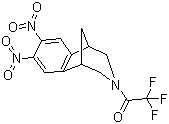 |
| Molecular Formula | C13H10F3N3O5 |
| Molecular Weight | 345.23 |
| CAS Registry Number | 230615-59-5 |
| EC Number | 638-808-6 |
| SMILES | C1C2CN(CC1C3=CC(=C(C=C23)[N+](=O)[O-])[N+](=O)[O-])C(=O)C(F)(F)F |
| Density | 1.6±0.1 g/cm3 Calc.* |
|---|---|
| Boiling point | 520.4±50.0 °C 760 mmHg (Calc.)* |
| Flash point | 268.5±30.1 °C (Calc.)* |
| Index of refraction | 1.584 (Calc.)* |
| * | Calculated using Advanced Chemistry Development (ACD/Labs) Software. |
| Hazard Symbols |   GHS02;GHS07 Danger Details GHS02;GHS07 Danger Details | ||||||||||||||||||||
|---|---|---|---|---|---|---|---|---|---|---|---|---|---|---|---|---|---|---|---|---|---|
| Risk Statements | H315-H319-H228 Details | ||||||||||||||||||||
| Safety Statements | P240-P210-P241-P264-P280-P302+P352-P370+P378-P337+P313-P305+P351+P338-P362+P364-P332+P313 Details | ||||||||||||||||||||
| Hazard Classification | |||||||||||||||||||||
| |||||||||||||||||||||
| Transport Information | UN 1325 | ||||||||||||||||||||
| SDS | Available | ||||||||||||||||||||
 chemBlink Chemical Story
|
2,3,4,5-Tetrahydro-7,8-dinitro-3-(trifluoroacetyl)-1,5-methano-1H-3-benzazepine, CAS 230615-59-5, is a highly functionalized bicyclic nitrogen compound used principally as a pharmaceutical intermediate in the synthesis of varenicline. Its molecular formula is C13H10F3N3O5 and its molecular weight is 345.23. The molecule contains a bridged benzazepine framework, two adjacent nitro groups on the aromatic portion, and a trifluoroacetyl group protecting the ring nitrogen. These features make it a particularly instructive example of how a complicated drug molecule can be assembled through carefully staged functional-group transformations. The connection with varenicline is unusually well documented. Pharmaceutical patent literature identifies CAS 230615-59-5 as one of the established intermediates used in the manufacture of varenicline and varenicline tartrate. Varenicline is a nicotinic acetylcholine receptor ligand developed as a smoking-cessation medicine. Its compact bridged tricyclic structure looks very different from this dinitro intermediate, but several of the atoms and structural relationships required for the final drug are already present at this stage. The 1,5-methano-benzazepine framework is especially important. It contains a nitrogen-containing seven-membered ring constrained by a carbon bridge. Such bridged structures restrict molecular flexibility and create a defined three-dimensional geometry. Constructing them early in a synthetic sequence allows later chemical steps to focus on changing functional groups rather than rebuilding the entire carbon skeleton. The two nitro groups at the 7- and 8-positions are temporary but strategically essential. Nitro groups are useful synthetic precursors to amines because catalytic hydrogenation can convert -NO2 into -NH2. In established varenicline processes, CAS 230615-59-5 is hydrogenated over a palladium catalyst to give the corresponding 7,8-diamino compound while the bridged ring system remains intact. This conversion illustrates a common theme in pharmaceutical synthesis. A functional group introduced at one stage does not necessarily appear in the final medicine. Instead, it may serve as a temporary form that is stable enough to survive earlier operations and can later be transformed into exactly the functionality needed for the next construction step. The adjacent diamines generated from the two nitro groups provide the key to building another ring. In a widely used sequence, the 7,8-diamino intermediate reacts with glyoxal. The two neighboring amino groups and the two-carbon dialdehyde condense and cyclize, creating the fused pyrazine portion characteristic of the varenicline skeleton. A pair of nitro groups that initially looks like simple aromatic substitution thus acts as a precursor to an entirely new nitrogen heterocycle. The trifluoroacetyl group has a different purpose. It protects the bridgehead nitrogen during nitration, hydrogenation, and subsequent transformations. Nitrogen atoms can be reactive and may interfere with other steps or alter reaction selectivity. Converting the amine into a trifluoroacetamide temporarily suppresses that reactivity. Once the more elaborate heterocyclic framework has been constructed, the protecting group can be removed to release the free amine. This sequence demonstrates the logic of protecting-group chemistry. A protecting group is not intended to remain in the final product. It functions more like a temporary cover placed over one reactive site while chemists perform difficult operations elsewhere. The trifluoroacetyl group is especially useful because the electron-withdrawing CF3 group strongly modifies the nitrogen's reactivity and the protecting group can later be cleaved under appropriate conditions. Manufacturing this intermediate also presents a classic problem of regioselectivity. Nitration of the protected bridged benzazepine must place nitro groups at the desired adjacent 7,8-positions. Patent work on varenicline impurities documents formation of alternative nitration products, including a 6,8-dinitro regioisomer. Such impurities matter because subsequent reduction and cyclization can transform them into closely related compounds that may persist through later stages. This is why modern pharmaceutical process chemistry is concerned not only with making the desired molecule but also with understanding every plausible neighboring structure. Patents describing varenicline manufacturing devote substantial attention to mononitro, alternative dinitro, monoamino, and alternative diamino compounds. Some are specifically monitored as process impurities because structural similarity can make them difficult to remove once they enter downstream reactions. Process development has continued long after the original varenicline synthesis was established. More recent patents describe alternative ways to prepare CAS 230615-59-5 and improvements to its conversion into the diamino and cyclized intermediates. The goals include reducing reaction steps, improving atom utilization, increasing yield, shortening reaction time, controlling impurities, and making production more practical on an industrial scale. CAS 230615-59-5 therefore illustrates several fundamental ideas of pharmaceutical chemistry at once. Its bridged skeleton establishes molecular shape. Nitro groups temporarily store future amino functionality. A trifluoroacetyl group protects a nitrogen until it is needed. Catalytic reduction changes the aromatic substituents, and condensation with glyoxal transforms two neighboring amines into a new heterocyclic ring. The compound itself is not varenicline and should not be assigned varenicline's pharmacological activity. Its importance lies in molecular construction. By the time this intermediate appears in the synthesis, much of the difficult three-dimensional framework has already been built, but several functional groups are still waiting to be transformed. It is a chemical snapshot of a drug molecule halfway through assembly: the final architecture is beginning to emerge, while temporary groups still reveal the strategy used to construct it. References 1. WO 2008/060487 A2. Polymorphs of Nicotinic Intermediates. Identification of CAS 230615-59-5 as an intermediate in the preparation of varenicline tartrate. https://patents.google.com/patent/WO2008060487A2/en 2. WO 2007/110730 A2. Varenicline Standards and Impurity Controls. Characterization of nitration, reduction, and process-related impurities in varenicline synthesis. https://patents.google.com/patent/WO2007110730A2/en 3. CN 113956255 A. Preparation Method of Varenicline Intermediate, Varenicline and Salt Thereof. Reduction of the 7,8-dinitro intermediate and subsequent glyoxal cyclization. https://patents.google.com/patent/CN113956255A/en 4. CN 115466214 B. Preparation Method of a Varenicline Intermediate. Process development for CAS 230615-59-5. https://patents.google.com/patent/CN115466214B/zh |
| Market Analysis Reports |