
Online Database of Chemicals from Around the World
| Shanghai PI Chemicals Ltd. | China | |||
|---|---|---|---|---|
 | www.pipharm.com | |||
 | +86 (21) 58953700 | |||
 | +86 (21) 58953701 | |||
 | sales@pipharm.com | |||
| Chemical distributor since 2007 | ||||
| chemBlink Standard supplier since 2026 | ||||
| Classification | Pharmaceutical intermediate >> Heterocyclic compound intermediate >> Pyrimidine compound >> Amine |
|---|---|
| Name | Mal-PEG4-amine |
| Synonyms | 1-[2-[2-[2-[2-(2-aminoethoxy)ethoxy]ethoxy]ethoxy]ethyl]pyrrole-2,5-dione |
| Molecular Structure | 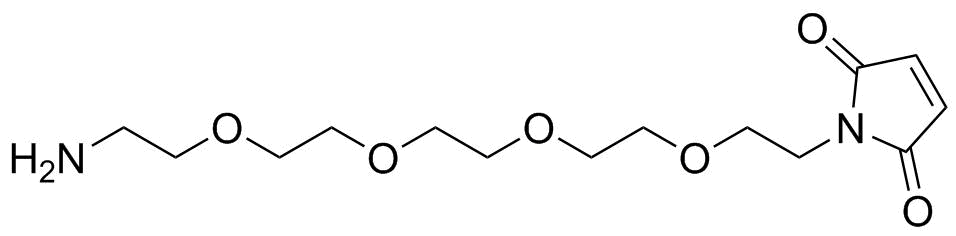 |
| Molecular Formula | C14H24N2O6 |
| Molecular Weight | 316.35 |
| CAS Registry Number | 2221042-92-6 |
| SMILES | C1=CC(=O)N(C1=O)CCOCCOCCOCCOCCN |
| Density | 1.2±0.1 g/cm3 Calc.* |
|---|---|
| Boiling point | 451.9±40.0 °C 760 mmHg (Calc.)* |
| Flash point | 227.1±27.3 °C (Calc.)* |
| Index of refraction | 1.507 (Calc.)* |
| * | Calculated using Advanced Chemistry Development (ACD/Labs) Software. |
| Hazard Symbols |  GHS07 Warning Details |
|---|---|
| Risk Statements | H302-H315-H319 Details |
| Safety Statements | P501-P270-P264-P280-P302+P352-P337+P313-P305+P351+P338-P362+P364-P332+P313-P301+P312+P330 Details |
| SDS | Available |
 chemBlink Chemical Story
|
Mal-PEG4-amine places two chemically different connection points on opposite ends of one defined spacer. Mal stands for maleimide, a five-membered imide ring with an electron-poor carbon–carbon double bond. At the far end of the ether-containing chain is a primary amine. The two nitrogen atoms therefore have very different environments: one belongs to the maleimide ring, while the other is the terminal amino group. Counting nitrogen atoms without identifying those environments would miss the purpose of the reagent. The maleimide end is used in thiol conjugation. A sulfur nucleophile can add across its double bond, producing a thiosuccinimide linkage. The original double bond is consumed, so the coupled product no longer has the same reactive maleimide end. The amine provides a different route for attachment, commonly through reaction with an appropriately activated carboxyl-derived group. Having two handles with different chemical preferences allows a linker to connect components that would not readily join each other directly. That is the design principle; actual selectivity still depends on conditions and on the other functional groups present. The PEG segment is a short, defined sequence of ether-containing units rather than a broad molecular-weight distribution. Its oxygen atoms offer sites for interaction with water, and its single bonds allow many conformations. It can separate the two reactive ends spatially without imposing one rigid orientation. These properties help explain its use in conjugation research. They do not show that the linker will make every attached molecule water-soluble, that all functional groups remain stable indefinitely, or that an untested conjugate will have a particular biological effect. The linkage formed at the maleimide end also has its own chemistry after conjugation. Research on antibody–drug conjugates has shown that some thiosuccinimide linkages can undergo a retro-Michael process, allowing loss or exchange of the attached group. Ring hydrolysis can instead produce a form resistant to that elimination pathway. Lyon and colleagues exploited this principle in 2014 by designing self-hydrolyzing maleimides. Their work illustrates why forming a covalent bond is not the end of evaluating a conjugate's stability. It does not demonstrate that this ordinary Mal-PEG4-amine reagent has the engineered behavior of their molecules. A separate uncertainty concerns how the material is supplied. PubChem represents CAS 2221042-92-6 as the neutral parent structure with the formula C₁₄H₂₄N₂O₆. A manufacturer's page uses the title Mal-PEG4-amine TFA salt while listing the same parent formula and mass. Those fields do not independently specify how much trifluoroacetate accompanies a weighed sample. The amine can be protonated, and a salt form may be relevant to the material specification, but the counterion amount cannot be recovered reliably from that abbreviated listing alone. The two reactions are also recognizable from different changes in the structure. Addition at the maleimide consumes a carbon–carbon double bond without removing the entire ring, while amide formation at the terminal amine creates a new bond to a carbonyl carbon supplied by the other component. Keeping track of those changes helps distinguish an unreacted linker from a singly attached intermediate and a doubly attached conjugate. Those are different analytical targets even when a product description gives all three the same informal linker label. This entry therefore preserves the source-list name and describes the parent linkage chemistry. For quantitative use, a batch-specific statement of counterion and water content is needed if those contributions affect the calculation. The scientific interest is in the combination of a thiol-facing ring, an amine-facing end and a flexible spacer, together with the recognition that the starting reagent, its supplied salt and its final conjugate are three distinguishable chemical objects. References: 1. PubChem. Mal-PEG4-amine, CID 134395768. https://pubchem.ncbi.nlm.nih.gov/compound/134395768 2. BroadPharm. Mal-PEG4-amine TFA salt, BP-24494, product specification. https://broadpharm.com/product/bp-24494 3. Lyon RP et al. Self-hydrolyzing maleimides improve the stability and pharmacological properties of antibody-drug conjugates. Nat Biotechnol. 2014;32:1059–1062. https://doi.org/10.1038/nbt.2968 |
| Market Analysis Reports |