
Online Database of Chemicals from Around the World
| Hangzhou Verychem Science And Technology Co., Ltd. | China | |||
|---|---|---|---|---|
 | www.verychem.com | |||
 | +86 (571) 8816-2785 +86 13606544505 | |||
 | +86 (571) 8816-2787 | |||
 | lucy@verychem.com | |||
| Chemical manufacturer since 2004 | ||||
| chemBlink Massive supplier since 2021 | ||||
| Shanghai Oripharm Co., Ltd. | China | |||
|---|---|---|---|---|
| www.oripharm.com.cn | |||
| +86 (21) 6439-6936 | |||
| +86 (21) 6481-4386 | |||
| info@oripharm.com.cn sales@oripharm.com.cn | |||
| Chemical distributor since 2003 | ||||
| chemBlink Standard supplier since 2006 | ||||
| Wilshire Technologies, Inc. | USA | |||
|---|---|---|---|---|
| www.wilshiretechnologies.com | |||
| +1 (609) 683-1117 | |||
| +1 (732) 274-0049 | |||
| Wilshire-info@evonik.com | |||
| Chemical manufacturer since 1997 | ||||
| chemBlink Standard supplier since 2010 | ||||
| Creative Peptides | USA | |||
|---|---|---|---|---|
| www.creative-peptides.com | |||
| +1 (631) 624-4882 | |||
| +1 (631) 614-7828 | |||
| info@creative-peptides.com | |||
| Chemical manufacturer | ||||
| chemBlink Standard supplier since 2010 | ||||
| Hangzhou Leap Chem Co., Ltd. | China | |||
|---|---|---|---|---|
| www.leapchem.com | |||
| +86 (571) 8771-1850 | |||
| market19@leapchem.com | |||
 | QQ Chat | |||
| Chemical manufacturer since 2006 | ||||
| chemBlink Standard supplier since 2015 | ||||
| Amadis Chemical Co., Ltd. | China | |||
|---|---|---|---|---|
| www.amadischem.com | |||
| +86 (571) 8992-5085 | |||
| +86 (571) 8992-5065 | |||
| sales@amadischem.com | |||
| Chemical manufacturer since 2010 | ||||
| chemBlink Standard supplier since 2015 | ||||
| Xinxiang Aurora Biotechnology Co., Ltd. | China | |||
|---|---|---|---|---|
| www.aurora-biotech.com | |||
| +86 (373) 308-8722 +86 18637352520 | |||
| +86 (373) 308-8722 | |||
| info@aurora-biotech.com | |||
| QQ Chat | |||
 | Skype Chat | |||
| Chemical manufacturer since 2012 | ||||
| chemBlink Standard supplier since 2017 | ||||
| Shanghai Perno Biotechnology Co., Ltd. | China | |||
|---|---|---|---|---|
| www.perno.cn | |||
| +86 18217200601 | |||
| bush@perno.cn | |||
| QQ Chat | |||
| Chemical manufacturer since 2020 | ||||
| chemBlink Standard supplier since 2023 | ||||
| Allbiosyn Biotechnology Co., Ltd. | China | |||
|---|---|---|---|---|
| www.allbiosyn.com | |||
| +86 15900695956 | |||
| info@allbiosyn.com | |||
 | WeChat: 15900695956 | |||
 | WhatsApp:86 15900695956 | |||
| Chemical manufacturer since 2023 | ||||
| chemBlink Standard supplier since 2024 | ||||
| BIOLOG Life Science Institute | Germany | |||
|---|---|---|---|---|
| www.biolog.de | |||
| +49 (421) 591-355 | |||
| +49 (421) 597-9713 | |||
| service@biolog.de | |||
| Chemical manufacturer | ||||
| W & J PharmaChem, Inc. | USA | |||
|---|---|---|---|---|
| www.wjpharmachem.com | |||
| +1 (301) 880-0624 | |||
| +1 (301) 434-9366 | |||
| info@wjpharmachem.com | |||
| Chemical manufacturer | ||||
| Classification | Biochemical >> Nucleoside drugs >> Nucleoside intermediate |
|---|---|
| Name | 2'-O-Methyladenosine |
| Synonyms | 2'-OMe-A |
| Molecular Structure | 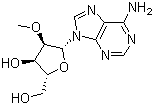 |
| Molecular Formula | C11H15N5O4 |
| Molecular Weight | 281.27 |
| Protein Sequence | N |
| CAS Registry Number | 2140-79-6 |
| SMILES | CO[C@@H]1[C@@H]([C@H](O[C@H]1N2C=NC3=C(N=CN=C32)N)CO)O |
| Melting point | 200-202 °C |
|---|---|
| Hazard Symbols |  GHS07 Warning Details |
|---|---|
| Risk Statements | H302 Details |
| Safety Statements | P280-P305+P351+P338 Details |
| SDS | Available |
 chemBlink Chemical Story
|
2'-O-methyladenosine, or 2'-O-MeA for short, is a modified nucleoside known for its enhanced stability and significant applications in biochemistry and medicine. This compound features a methyl group added to the 2'-hydroxyl group of the ribose sugar in adenosine, which improves its chemical properties and functionality. The development of 2'-O-methyladenosine stemmed from the need to create more stable nucleoside analogs for a variety of scientific and therapeutic uses. By replacing the 2'-hydroxyl group with a methyl group, researchers aimed to produce a nucleoside that would resist enzymatic degradation and maintain structural integrity under a variety of conditions. This modification was introduced to improve the durability and performance of adenosine-based compounds. 2'-O-methyladenosine plays a vital role in RNA research due to its enhanced stability. The 2'-O-methyl modification protects RNA molecules from ribonuclease degradation, allowing for more precise studies of RNA structure, function, and interactions. This stability is essential for the production of reliable RNA probes and constructs used in a wide range of biological studies. In nucleic acid synthesis, 2'-O-MeA is used to create more stable RNA and DNA sequences. The incorporation of this modified nucleoside improves the robustness of oligonucleotides, which is critical for gene expression studies, diagnostic assays, and therapeutic applications. The stability provided by 2'-O-MeA ensures that the synthesized nucleic acid maintains its integrity and functionality over time. The stability of 2'-O-methyladenosine makes it a valuable candidate for therapeutic development. By incorporating this modification, researchers can design nucleoside analogs with enhanced pharmacokinetic properties and prolonged activity. These modified nucleosides hold promise for the development of more effective antiviral, anticancer, and gene therapies, potentially improving therapeutic efficacy and reducing dosing frequency. References 2023. PCIF1, the only methyltransferase of N6,2-O-dimethyladenosine. Cancer Cell International, 23(1), 221. DOI: 10.1186/s12935-023-03066-7 2023. A systems-level mass spectrometry-based technique for accurate and sensitive quantification of the RNA cap epitranscriptome. Nature Protocols, 18(10), reverence > 3100-3136. DOI: 10.1038/s41596-023-00857-0 2024. The eRF1 degrader SRI-41315 acts as a molecular glue at the ribosomal decoding center. Nature Chemical Biology, 20(7), 879-889. DOI: 10.1038/s41589-023-01521-0 |
| Market Analysis Reports |