
Online Database of Chemicals from Around the World
| HuNan Huibaiyi New Materials Co; Ltd. | China | |||
|---|---|---|---|---|
 | www.hbsjxcl.com | |||
 | +86 13319523173 | |||
 | ivy@hnhbsj.com | |||
 | QQ Chat | |||
 | WeChat: 13319523173 | |||
| Chemical manufacturer since 2014 | ||||
| chemBlink Standard supplier since 2026 | ||||
| Classification | Chemical reagent >> Organic reagent >> Phosphorous compound |
|---|---|
| Name | Sodium naphthalen-1-yl phosphate hydrate |
| Synonyms | Naphthalen-1-yl phosphate sodium hydrate |
| Molecular Structure | 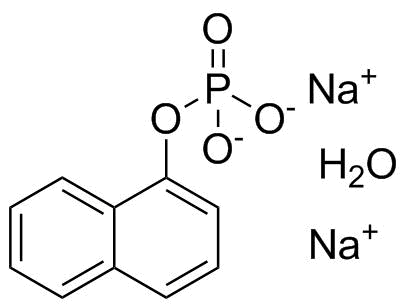 |
| Molecular Formula | C10H9Na2O5P |
| Molecular Weight | 286.13 |
| CAS Registry Number | 207569-06-0 |
| EC Number | 681-541-5 |
| SMILES | C1=CC=C2C(=C1)C=CC=C2OP(=O)([O-])[O-].O.[Na+].[Na+] |
| Melting point | >300 °C (Expl.) |
|---|---|
| Hazard Symbols |  GHS07 Warning Details GHS07 Warning Details |
|---|---|
| Risk Statements | H315-H319-H335 Details |
| Safety Statements | P261-P264-P264+P265-P271-P280-P302+P352-P304+P340-P305+P351+P338-P319-P321-P332+P317-P337+P317-P362+P364-P403+P233-P405-P501 Details |
| SDS | Available |
 chemBlink Chemical Story
|
Sodium naphthalen-1-yl phosphate hydrate is the hydrated sodium salt form of naphthalen-1-yl phosphate, an aromatic phosphate ester derived from 1-naphthol. Structurally, the compound consists of a naphthalene ring system linked through an oxygen atom to a phosphate group, with sodium ions balancing the negative charge of the phosphate and water molecules incorporated into the crystal structure as waters of hydration. The central structural feature is the naphthalene nucleus, which is composed of two fused benzene rings forming a planar aromatic system with an extended conjugated π-electron network. This aromatic framework contributes hydrophobic character and allows intermolecular interactions such as π–π stacking in the solid state and in molecular assemblies. Compared with single-ring aromatic systems, naphthalene derivatives generally exhibit greater hydrophobicity and stronger aromatic interactions because of the larger conjugated surface. The phosphate ester group is attached at the 1-position of the naphthalene ring through an oxygen atom. Phosphate esters are highly polar functional groups containing a phosphorus atom bonded to oxygen atoms in a tetrahedral arrangement. The phosphate region contributes strong ionic character and extensive hydrogen-bonding capability. In the sodium salt form, one or more acidic phosphate protons are replaced by sodium cations, creating ionic interactions that increase compatibility with aqueous environments. The sodium ions primarily serve a charge-balancing function and influence physical properties such as crystal structure, solubility, and dissolution behavior. In aqueous media, the ionic interactions between sodium and phosphate are generally weakened through hydration, allowing dissociation into solvated ions. The hydrate designation indicates that water molecules are incorporated into the crystalline lattice rather than being chemically bound to the molecule itself. Waters of hydration frequently influence crystal packing, stability, melting characteristics, and hygroscopic behavior. The exact amount of hydration can vary depending on preparation and storage conditions. From a physicochemical perspective, sodium naphthalen-1-yl phosphate hydrate possesses both hydrophobic and hydrophilic regions. The fused aromatic ring system contributes nonpolar characteristics, while the phosphate group and sodium counterions provide strong polarity and ionic behavior. This combination creates an amphiphilic molecular profile in which solubility behavior reflects the balance between aromatic and ionic domains. The phosphate ester linkage is the principal chemically reactive site of the molecule. Phosphate esters may undergo hydrolysis under enzymatic or sufficiently strong chemical conditions, yielding the corresponding alcohol or phenolic compound and inorganic phosphate species. In this case, cleavage of the phosphate ester bond would generate 1-naphthol and phosphate-containing products. Compounds belonging to the aryl phosphate ester class have been widely used in biochemical studies, analytical chemistry, and synthetic chemistry because phosphate esters can serve as substrates or intermediates in reactions involving phosphatases and related transformations. However, any specific application for sodium naphthalen-1-yl phosphate hydrate should be limited to documented literature for the exact material. Overall, sodium naphthalen-1-yl phosphate hydrate is an ionic aromatic phosphate ester composed of a naphthalene ring linked to a phosphate group and stabilized as a hydrated sodium salt. Its key structural characteristics are an extended aromatic system combined with a strongly polar phosphate functionality, giving rise to distinctive electronic, solubility, and intermolecular interaction properties. References 2013. A simple method for deriving functional MSCs and applied for osteogenesis in 3D scaffolds. Scientific Reports. DOI: 10.1038/srep02243 2011. NickFects, Phosphorylated Derivatives of Transportan 10 for Cellular Delivery of Oligonucleotides. International Journal of Peptide Research and Therapeutics. DOI: 10.1007/s10989-011-9252-1 |
| Market Analysis Reports |