
Online Database of Chemicals from Around the World
| Hangzhou Verychem Science And Technology Co., Ltd. | China | |||
|---|---|---|---|---|
 | www.verychem.com | |||
 | +86 (571) 8816-2785 +86 13606544505 | |||
 | +86 (571) 8816-2787 | |||
 | lucy@verychem.com | |||
| Chemical manufacturer since 2004 | ||||
| chemBlink Massive supplier since 2021 | ||||
| BOC Sciences | USA | |||
|---|---|---|---|---|
| www.bocsci.com | |||
| +1 (631) 485-4226 | |||
| +1 (631) 614-7828 | |||
| info@bocsci.com | |||
| Chemical manufacturer | ||||
| chemBlink Standard supplier since 2010 | ||||
| Alfa Chemistry | USA | |||
|---|---|---|---|---|
| www.alfa-chemistry.com | |||
| +1 (516) 734-6573 | |||
| +1 (516) 927-0118 | |||
| support@alfa-chemistry.com | |||
| Chemical manufacturer since 2005 | ||||
| chemBlink Standard supplier since 2012 | ||||
| Classification | API >> Other chemicals |
|---|---|
| Name | Derquantel |
| Synonyms | 2-Deoxoparaherquamide |
| Molecular Structure | 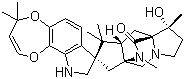 |
| Molecular Formula | C28H37N3O4 |
| Molecular Weight | 479.61 |
| CAS Registry Number | 187865-22-1 |
| SMILES | C[C@]1(CCN2[C@]13C[C@@H]4[C@](C2)(C[C@]5(C4(C)C)CNC6=C5C=CC7=C6OC=CC(O7)(C)C)N(C3=O)C)O |
| Density | 1.3±0.1 g/cm3 Calc.* |
|---|---|
| Boiling point | 641.3±55.0 °C 760 mmHg (Calc.)* |
| Flash point | 341.7±31.5 °C (Calc.)* |
| Index of refraction | 1.666 (Calc.)* |
| * | Calculated using Advanced Chemistry Development (ACD/Labs) Software. |
| SDS | Available |
|---|---|
 chemBlink Chemical Story
|
Derquantel is a semisynthetic anthelmintic belonging to the spiroindole class and was developed for control of gastrointestinal nematodes in livestock. It acts as an antagonist at nematode nicotinic acetylcholine receptors, disrupting neuromuscular signaling and producing flaccid paralysis of susceptible worms. Derquantel is especially known in veterinary medicine through combination with the macrocyclic lactone abamectin, marketed for sheep in some jurisdictions. Combining agents with different mechanisms broadens parasite control and was developed in the context of widespread resistance to older anthelmintic classes. Chemically, derquantel's densely fused spirocyclic framework distinguishes it sharply from simpler benzimidazole or imidazothiazole dewormers. Its story therefore connects natural-product-inspired molecular architecture, parasite neurobiology, and the practical challenge of maintaining effective livestock parasite control. Exact chemical identity matters because free forms, salts, stereoisomers, hydrates, metabolites, intermediates, and finished products can carry different registry numbers even when their names are closely related. These distinctions affect molecular weight, physical properties, analytical standards, formulation, and interpretation of literature. A reliable chemical database therefore follows the exact substance instead of automatically transferring every property of a related form. Functional groups are also a map of intended reactivity. Carbonyls, alcohols, amines, halides, alkenes, and heterocycles provide different opportunities for bond formation, while hydrocarbon frameworks influence shape and solubility. In multistep synthesis, the usefulness of an intermediate often comes from being able to transform one position selectively while leaving another group available for a later operation. Modern chemical development depends as much on characterization as on synthesis. Identity, purity, stereochemistry, water or salt content, and process-related impurities may all need control. Well-characterized intermediates and reference materials therefore matter even when they never become a final commercial product: they make complex manufacturing and research reproducible. A responsible Chemical Story distinguishes documented use from structural possibility. A familiar molecular scaffold can suggest a hypothesis, but resemblance alone does not establish a biological target, approved indication, or commercial application. When exact-CAS literature is limited, verified chemistry and clearly documented uses are more informative than speculation. Seen broadly, practical performance emerges from the whole molecular system. Structure, stereochemistry, physical form, synthetic route, reaction environment, and, for biological molecules, metabolism can all determine what a substance actually does. Connecting these details to a documented historical, industrial, or biological role turns a registry entry into a meaningful chemical story. Exact chemical identity matters because free forms, salts, stereoisomers, hydrates, metabolites, intermediates, and finished products can carry different registry numbers even when their names are closely related. These distinctions affect molecular weight, physical properties, analytical standards, formulation, and interpretation of literature. A reliable chemical database therefore follows the exact substance instead of automatically transferring every property of a related form. Functional groups are also a map of intended reactivity. Carbonyls, alcohols, amines, halides, alkenes, and heterocycles provide different opportunities for bond formation, while hydrocarbon frameworks influence shape and solubility. In multistep synthesis, the usefulness of an intermediate often comes from being able to transform one position selectively while leaving another group available for a later operation. Modern chemical development depends as much on characterization as on synthesis. Identity, purity, stereochemistry, water or salt content, and process-related impurities may all need control. Well-characterized intermediates and reference materials therefore matter even when they never become a final commercial product: they make complex manufacturing and research reproducible. References: 1. Kaminsky R et al. A new class of anthelmintics effective against drug-resistant nematodes. Nature. 2008. 2. Veterinary pharmacology literature on derquantel and derquantel-abamectin combinations. 3. European Medicines Agency / veterinary product information for derquantel-containing combinations. |
| Market Analysis Reports |