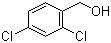
2,4-Dichlorobenzyl alcohol is familiar to many people without being recognized by name. It is one of the antiseptic active ingredients used together with amylmetacresol in several medicated sore-throat lozenges. The molecule is a benzyl alcohol bearing two chlorine atoms on the aromatic ring, and its local antimicrobial activity made it useful in products intended to act in the mouth and throat rather than throughout the body.
That distinction matters. A lozenge dissolves slowly and exposes the oropharyngeal surface to the active ingredients. The goal is local action: reduce susceptible microorganisms and provide symptomatic relief in an irritated throat. This is different from a systemic antibiotic, which is absorbed and distributed to treat a bacterial infection at therapeutic concentrations in tissues. Most uncomplicated sore throats are self-limiting and many are viral, so an antiseptic lozenge should not be described as a substitute for antibiotics when antibiotics are clinically indicated.
Laboratory studies have examined the combination of 2,4-dichlorobenzyl alcohol and amylmetacresol against bacteria associated with the respiratory tract. Matthews, Atkinson, and Shephard reported rapid bactericidal activity of lozenge formulations against a spectrum of organisms in vitro. Other work has investigated effects against enveloped respiratory viruses. These studies support local antimicrobial activity, but combination-product data must be interpreted carefully: an effect measured for the two active ingredients together cannot automatically be assigned to 2,4-dichlorobenzyl alcohol alone.
The combination also appears to have sensory and local pharmacological effects beyond simple killing of microorganisms. Medicated lozenges can increase salivation, lubricate the throat, and provide a soothing effect from the dosage form itself. Some experimental work has explored local anesthetic-like actions of the active mixture. Again, formulation, concentration, dissolution time, flavoring, and the companion antiseptic all contribute to what the user experiences.
This makes 2,4-dichlorobenzyl alcohol a useful case study in how evidence should be described. In vitro antimicrobial activity is not the same as proving that one ingredient cures a clinical infection. Symptom relief in a combination lozenge is not proof that every effect comes from one molecule. Good pharmaceutical interpretation separates the chemical property of an active ingredient from the performance of the finished dosage form.
The compound is memorable because it sits between chemistry and everyday medicine. A small chlorinated aromatic alcohol can contribute to local antiseptic action, but its real-world value depends on delivery, combination with other ingredients, and appropriate clinical expectations. The story is therefore as much about careful interpretation of evidence as it is about antimicrobial chemistry.
References:
1. Matthews D., Atkinson R., Shephard A. Spectrum of bactericidal action of amylmetacresol/2,4-dichlorobenzyl alcohol lozenges. International Journal of General Medicine. 2018, 11, 451-456. DOI: 10.2147/IJGM.S184406.
2. Morokutti-Kurz M. et al. Antiviral activity of amylmetacresol/2,4-dichlorobenzyl alcohol lozenge actives. International Journal of General Medicine. 2017, 10, 53-60. DOI: 10.2147/IJGM.S120665.
3. Tan T.W. et al. Evidence review protocol for antiseptic lozenges in sore throat. DOI: 10.11124/JBISRIR-2016-003034.
4. PubChem. 2,4-Dichlorobenzyl alcohol, CAS 1777-82-8.
|








 GHS05;GHS07 Danger Details
 chemBlink Chemical Story