
Online Database of Chemicals from Around the World
| Laizhou Laiyu Chemical Co., Ltd. | China | |||
|---|---|---|---|---|
 | www.laiyu.com | |||
 | +86 (535) 271-9337 | |||
 | liyunxia0707@163.com | |||
 | QQ Chat | |||
 | WeChat: 15864067774 | |||
 | WhatsApp:8615864067774 | |||
| Chemical manufacturer since 1998 | ||||
| chemBlink Standard supplier since 2008 | ||||
| Hefei TNJ Chemical Industry Co., Ltd. | China | |||
|---|---|---|---|---|
| www.tnjchem.com | |||
| +86 (551) 6541-8684 | |||
 | +86 (551) 6541-8697 | |||
| sales@tnjchem.com | |||
| Chemical manufacturer since 2001 | ||||
| chemBlink Standard supplier since 2010 | ||||
| Alfa Chemistry | USA | |||
|---|---|---|---|---|
| www.alfa-chemistry.com | |||
| +1 (516) 734-6573 | |||
| +1 (516) 927-0118 | |||
| support@alfa-chemistry.com | |||
| Chemical manufacturer since 2005 | ||||
| chemBlink Standard supplier since 2012 | ||||
| Qingdao Highcloud Tech Material Co., Ltd. | China | |||
|---|---|---|---|---|
| www.highcloudtech.com.cn | |||
| +86 86-15864067774 | |||
| info@highcloudtech.com.cn | |||
| QQ Chat | |||
| WeChat: 8615864067774 | |||
| WhatsApp:8615864067774 | |||
| Chemical manufacturer since 2023 | ||||
| chemBlink Standard supplier since 2026 | ||||
| Classification | Inorganic chemical industry >> Inorganic salt >> Metal sulfides and sulfates |
|---|---|
| Name | Kieserite |
| Synonyms | Magnesium sulphate monohydrate |
| Molecular Structure | 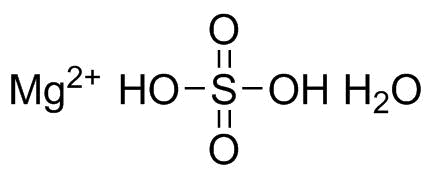 |
| Molecular Formula | MgSO4.H2O |
| Molecular Weight | 138.38 |
| CAS Registry Number | 14567-64-7 |
| EC Number | 688-936-1 |
| SMILES | O.OS(=O)(=O)O.[Mg+2] |
 chemBlink Chemical Story
|
Kieserite is a naturally occurring hydrated magnesium sulfate mineral with the chemical formula MgSO₄·H₂O. It is a monoclinic sulfate mineral composed of magnesium cations (Mg²⁺), sulfate anions (SO₄²⁻), and one molecule of crystallization water per formula unit. It is commonly found in evaporite deposits formed by the evaporation of saline waters such as seawater or brines. The fundamental structural unit of kieserite is the magnesium ion coordinated by oxygen atoms from surrounding sulfate groups and water molecules. Magnesium in this mineral typically adopts octahedral coordination geometry, in which it is surrounded by six oxygen atoms. These oxygen atoms come from sulfate tetrahedra and the water molecule, forming a tightly bound crystal lattice. The sulfate group is a tetrahedral oxyanion consisting of a central sulfur atom covalently bonded to four oxygen atoms. The sulfur atom is in its highest common oxidation state (+6), and the S–O bonds are highly polar. The sulfate groups act as bridging units in the crystal structure, linking magnesium centers through ionic and coordinate interactions. This contributes to the rigidity and stability of the mineral framework. The single water molecule per formula unit is structurally bound within the lattice and is referred to as water of crystallization. This water participates in hydrogen bonding with sulfate oxygen atoms, helping stabilize the crystal structure. Unlike loosely adsorbed water, this structural water is an integral part of the mineral’s composition and affects its thermal behavior and dehydration properties. Kieserite belongs to the monoclinic crystal system, meaning its crystal lattice is defined by three unequal axes with one oblique angle. This crystallographic arrangement reflects the directional bonding between magnesium, sulfate groups, and water molecules. The structure is relatively dense and compact compared to more highly hydrated magnesium sulfate minerals. Upon heating or exposure to dry conditions, kieserite can undergo dehydration, losing its water of crystallization and transforming into other magnesium sulfate phases with different hydration states. This dehydration behavior is important in geochemical processes and in industrial contexts where magnesium sulfate materials are processed or utilized. From a geochemical perspective, kieserite typically forms in environments where evaporation concentrates dissolved magnesium and sulfate ions. Such environments include salt lakes, evaporitic marine basins, and sedimentary evaporite sequences. Its formation is associated with progressive evaporation stages where more soluble salts have already precipitated. Physically, kieserite is usually colorless to white or gray and may appear as granular, massive, or crystalline aggregates. It has moderate hardness and relatively high solubility compared with many other sulfate minerals, although its hydration state influences its dissolution behavior. Chemically, the most significant interactions in kieserite are ionic bonds between Mg²⁺ cations and SO₄²⁻ anions, along with hydrogen bonding involving the water molecule. The sulfate group itself is chemically stable under normal environmental conditions, while the magnesium ion remains in a +2 oxidation state and does not undergo redox changes in typical geologic settings. Overall, kieserite is a hydrated magnesium sulfate mineral characterized by a monoclinic crystal structure composed of Mg²⁺ ions coordinated to sulfate tetrahedra and water molecules. Its defining feature is the presence of one structurally bound water molecule per formula unit, which plays a key role in stabilizing the crystal lattice and controlling its dehydration behavior. References 2025. Seasonally dependent formation of sulfates in the Basque Lakes, British Columbia, as analogous to “cold and wet” and “warm and wet” Mars. Earth and Space Science. DOI: 10.1029/2025ea004571 2023. On the diversity and formation modes of Martian minerals. Journal of Geophysical Research: Planets. DOI: 10.1029/2023je007865 2020. Crystallography relevant to Mars and Galilean icy moons: crystal behavior of kieserite-type monohydrate sulfates at extraterrestrial conditions down to 15 K. IUCrJ. DOI: 10.1107/s2052252521012720 |
| Market Analysis Reports |