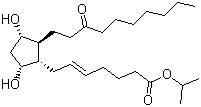
Isopropyl unoprostone is the ester form of unoprostone. Its name describes a specific structural change: the carboxyl group is joined to an isopropyl group through oxygen. That change leaves the stereochemical framework of the molecule in place while altering the properties of the terminal group. The ester and the corresponding free acid are therefore different chemical entities, even when they are discussed together in the context of an ophthalmic medicine.
The historical FDA labeling for Rescula identifies unoprostone isopropyl as the active ingredient of an ophthalmic formulation used to lower elevated intraocular pressure. The label describes hydrolysis to the corresponding free acid after ocular administration. This is a useful illustration of how a molecule as formulated and a molecule present after metabolism can differ. An ester can mask the ionizable acid group, and hydrolysis unmasks it. Neither step can be inferred reliably merely from seeing a similar ring structure in another prostaglandin analogue.
Pressure inside the eye depends partly on the relationship between production of aqueous humor and its drainage. Measuring a pressure change provides an endpoint for ophthalmic studies, but it does not by itself identify the full pathway by which a compound acts. Nor does a historical labeled use establish current commercial availability or suitability for a particular patient. Those are distinct questions requiring current clinical information.
An assay that measures only the ester and one that measures the acid answer different questions. Disappearance of the ester can indicate transformation, but a measurement of the corresponding acid helps establish what product appeared. The distinction is important when interpreting tissue or formulation studies. A structural drawing suggests the possible conversion; it does not measure its extent or rate.
This compound's story is therefore best told through the relationship between functional group, formulation, metabolism, and measurement. The administered ester has a defined identity, and the free acid produced by hydrolysis has another. A third level is the clinical effect of the complete formulation. Keeping these levels separate is more informative than assuming that all prostaglandin-related molecules, or all esters and amides in the family, can be treated interchangeably.
References:
1. FDA substance identity record. https://precision.fda.gov/uniisearch/srs/unii/5M161S5O5P
2. FDA. Historical Rescula prescribing information. https://www.accessdata.fda.gov/drugsatfda_docs/label/2000/21214lbl.pdf
|







 chemBlink Chemical Story