
Online Database of Chemicals from Around the World
| Wuhan Kemi-works Chemical Co., Ltd. | China | |||
|---|---|---|---|---|
 | www.kemiworks.net | |||
 | +86 (27) 8573-6489 | |||
 | +86 (27) 8573-6485 | |||
 | info@kemiworks.net sales@kemiworks.com | |||
| Chemical manufacturer | ||||
| chemBlink Premium supplier since 2011 | ||||
| Classification | Catalysts and additives >> Plastic rubber additive |
|---|---|
| Name | Diethylene glycol dibenzoate |
| Synonyms | 2,2'-Oxydiethylene dibenzoate |
| Molecular Structure | 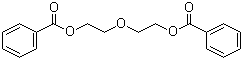 |
| Molecular Formula | C18H18O5 |
| Molecular Weight | 314.34 |
| CAS Registry Number | 120-55-8 |
| EC Number | 204-407-6 |
| SMILES | C1=CC=C(C=C1)C(=O)OCCOCCOC(=O)C2=CC=CC=C2 |
| Density | 1.2±0.1 g/cm3 Calc.* |
|---|---|
| Melting point | 33.5 °C (Expl.) |
| Boiling point | 408.0 °C 760 mmHg (Calc.)*, 451.8 - 454.6 °C (Expl.) |
| Flash point | 173.0±21.0 °C (Calc.)*, 13 °C (Expl.) |
| Index of refraction | 1.553 (Calc.)*, 1.544 (Expl.) |
| * | Calculated using Advanced Chemistry Development (ACD/Labs) Software. |
| Hazard Symbols |  GHS09; Details GHS09; Details | ||||||||||||
|---|---|---|---|---|---|---|---|---|---|---|---|---|---|
| Risk Statements | H411 Details | ||||||||||||
| Safety Statements | P273-P391-P501 Details | ||||||||||||
| Hazard Classification | |||||||||||||
| |||||||||||||
| SDS | Available | ||||||||||||
 chemBlink Chemical Story
|
Diethylene glycol dibenzoate is an aromatic ester compound formed by esterification of both hydroxyl groups of diethylene glycol with benzoic acid. Structurally, it consists of a flexible diethylene glycol backbone linked at both ends to benzoate groups, creating a molecule that combines an ether-containing aliphatic chain with two aromatic ester moieties. It belongs to the broader family of benzoate esters and is commonly used as a plasticizer and specialty formulation component. The molecule contains three principal structural elements: two benzoate ester groups, an ether linkage, and an ethylene glycol-derived chain. The ester functionalities contribute polarity and susceptibility to hydrolysis under sufficiently acidic or basic conditions, while the ether oxygen in the central chain increases flexibility and influences intermolecular interactions. The phenyl rings add hydrophobic character and increase molecular size and polarizability. From an electronic standpoint, the ester carbonyl groups are the most strongly polarized regions of the molecule. Resonance delocalization within the benzoate portions stabilizes the ester linkage and influences molecular behavior. The aromatic rings are relatively electron-rich compared with the carbonyl carbons, while the oxygen atoms act as hydrogen-bond acceptors. A notable property of diethylene glycol dibenzoate is its balance of flexibility and intermolecular compatibility. The diethylene glycol segment provides rotational freedom, whereas the aromatic benzoate groups increase molecular rigidity and enhance interactions with polymer matrices. This balance makes the compound effective as a plasticizer, where it reduces intermolecular forces between polymer chains and increases flexibility and processability. The compound is widely used in polymer systems, adhesives, sealants, and coatings. In plasticized materials, it lowers glass-transition temperatures and improves flexibility without requiring large quantities of additive. Benzoate-based plasticizers are often used as alternatives to some traditional phthalate plasticizers in certain applications. Physicochemically, diethylene glycol dibenzoate is typically a colorless to pale liquid with relatively low volatility compared with smaller esters. Its aromatic groups increase molecular weight and hydrophobicity, while the ether and ester oxygens contribute moderate polarity. Consequently, it generally exhibits low water solubility but good compatibility with many organic materials and polymer systems. Chemically, the ester bonds can undergo hydrolysis to yield benzoic acid and diethylene glycol under strongly acidic or alkaline conditions. Under ordinary conditions, however, the molecule is generally stable and suitable for industrial use. Overall, diethylene glycol dibenzoate is a bifunctional aromatic ester characterized by two benzoate groups attached to a flexible glycol-derived backbone. Its significance lies primarily in materials chemistry, where its combination of polarity, flexibility, and compatibility makes it useful as a plasticizer and formulation additive in polymers and related industrial systems. References 2026. Assessing the environmental impact of disposable polymer gloves: AGREEMIP criteria evaluations. Clean Technologies and Environmental Policy. DOI: 10.1007/s10098-026-03415-w 2025. Application of Maleic Anhydride-Modified Polyethylene (Review). Polymer Science, Series D. DOI: 10.1134/s1995421225700182 |
| Market Analysis Reports |