
Online Database of Chemicals from Around the World
| Simagchem Corporation | China | |||
|---|---|---|---|---|
 | www.simagchem.com | |||
 | +86 13806087780 | |||
 | +86 (592) 268-0237 | |||
 | sale@simagchem.com | |||
| Chemical manufacturer since 2002 | ||||
| chemBlink Standard supplier since 2008 | ||||
| HBCChem, Inc. | USA | |||
|---|---|---|---|---|
| www.hbcchem-inc.com | |||
| +1 (510) 219-6317 | |||
| +1 (510) 675-0318 | |||
| sales@hbcchem-inc.com | |||
| Chemical manufacturer | ||||
| chemBlink Standard supplier since 2008 | ||||
| Survival Technologies Pvt Ltd | India | |||
|---|---|---|---|---|
| www.survivaltechnologies.in | |||
| +91 (22) 4212-8221 | |||
| +91 (22) 4212-8226 | |||
| info@survivaltechnologies.in | |||
| Chemical manufacturer since 2006 | ||||
| chemBlink Standard supplier since 2009 | ||||
| Hefei TNJ Chemical Industry Co., Ltd. | China | |||
|---|---|---|---|---|
| www.tnjchem.com | |||
| +86 (551) 6541-8684 | |||
| +86 (551) 6541-8697 | |||
| sales@tnjchem.com | |||
| Chemical manufacturer since 2001 | ||||
| chemBlink Standard supplier since 2010 | ||||
| Wilshire Technologies, Inc. | USA | |||
|---|---|---|---|---|
| www.wilshiretechnologies.com | |||
| +1 (609) 683-1117 | |||
| +1 (732) 274-0049 | |||
| Wilshire-info@evonik.com | |||
| Chemical manufacturer since 1997 | ||||
| chemBlink Standard supplier since 2010 | ||||
| BOC Sciences | USA | |||
|---|---|---|---|---|
| www.bocsci.com | |||
| +1 (631) 485-4226 | |||
| +1 (631) 614-7828 | |||
| info@bocsci.com | |||
| Chemical manufacturer | ||||
| chemBlink Standard supplier since 2010 | ||||
| Jiangxi Time Chemical Co., Ltd. | China | |||
|---|---|---|---|---|
| www.groupchem.com | |||
| +86 (794) 718-3888 718-3887 526-9970 +86 13867635890 | |||
| +86 (794) 526-9668 / 526-9166 | |||
| sales@groupchem.com | |||
 | QQ Chat | |||
| Chemical manufacturer since 2010 | ||||
| chemBlink Standard supplier since 2011 | ||||
| Dongfan Chem (Shanghai) Co., Ltd. | China | |||
|---|---|---|---|---|
| www.dfanchem.com | |||
| +86 (21) 3450-0607 +86 13391355195 | |||
| +86 (21) 3332-1290 | |||
| sales@dfanchem.com | |||
| QQ Chat | |||
| Chemical manufacturer since 2007 | ||||
| chemBlink Standard supplier since 2014 | ||||
| Hangzhou Leap Chem Co., Ltd. | China | |||
|---|---|---|---|---|
| www.leapchem.com | |||
| +86 (571) 8771-1850 | |||
| market19@leapchem.com | |||
| QQ Chat | |||
| Chemical manufacturer since 2006 | ||||
| chemBlink Standard supplier since 2015 | ||||
| Neostar United (Changzhou) Industrial Co., Ltd. | China | |||
|---|---|---|---|---|
| www.neostarunited.com | |||
| +86 (519) 8555-7386 +86 18015025600 | |||
| +86 (519) 8555-7389 | |||
| marketing1@neostarunited.com | |||
| Chemical distributor since 2014 | ||||
| chemBlink Standard supplier since 2020 | ||||
| Zoupingtongfengchemical Co. Ltd. | China | |||
|---|---|---|---|---|
| www.tongfeng-chem.com | |||
| +86 18769685991 | |||
| tongfengchem@163.com | |||
| Chemical manufacturer since 2014 | ||||
| chemBlink Standard supplier since 2023 | ||||
| Zley Holdings (Suzhou) Co., Ltd. | China | |||
|---|---|---|---|---|
| www.zleygroup.com | |||
| +86 (0512) 8777-5990 +86 18626205929 | |||
| +86 (0512) 8777-5990 | |||
| huangzhenzhou@zleygroup.com | |||
 | WhatsApp:+852-9061-4262 | |||
| Chemical manufacturer since 2019 | ||||
| chemBlink Standard supplier since 2026 | ||||
| Zhejiang Realsun Chemical Industry Co., Ltd. | China | |||
|---|---|---|---|---|
| www.realsunchem.com | |||
| +86 (576) 8831-2598 | |||
| +86 (576) 8831-2589 | |||
| marketing@realsunchem.com | |||
| Chemical manufacturer | ||||
| Alfa Aesar. | USA | |||
|---|---|---|---|---|
| www.alfa.com | |||
| +1 (978) 521-6300 | |||
| +1 (978) 521-6350 | |||
| info@alfa.com | |||
| Chemical manufacturer | ||||
| Classification | Chemical reagent >> Organic reagent >> Fatty alcohol |
|---|---|
| Name | 1,2-Octanediol |
| Synonyms | Octane-1,2-diol |
| Molecular Structure | 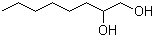 |
| Molecular Formula | C8H18O2 |
| Molecular Weight | 146.23 |
| CAS Registry Number | 1117-86-8 |
| EC Number | 214-254-7 |
| SMILES | CCCCCCC(CO)O |
| Density | 0.9±0.1 g/cm3 Calc.* |
|---|---|
| Melting point | 36 - 38 °C (Expl.) |
| Boiling point | 243.0±8.0 °C 760 mmHg (Calc.)*, 293.9 - 295.3 °C (Expl.) |
| Flash point | 109.1±13.0 °C (Calc.)*, 140 °C (Expl.) |
| Solubility | water: 3 g/L (20 °C) (Expl.) |
| Index of refraction | 1.453 (Calc.)* |
| * | Calculated using Advanced Chemistry Development (ACD/Labs) Software. |
| Hazard Symbols |  GHS07 Warning Details GHS07 Warning Details | ||||||||||||||||||||||||
|---|---|---|---|---|---|---|---|---|---|---|---|---|---|---|---|---|---|---|---|---|---|---|---|---|---|
| Risk Statements | H319 Details | ||||||||||||||||||||||||
| Safety Statements | P264+P265-P280-P305+P351+P338-P337+P317 Details | ||||||||||||||||||||||||
| Hazard Classification | |||||||||||||||||||||||||
| |||||||||||||||||||||||||
| SDS | Available | ||||||||||||||||||||||||
 chemBlink Chemical Story
|
1,2-Octanediol, CAS 1117-86-8, is an eight-carbon vicinal diol widely known in the cosmetics industry by its INCI name, caprylyl glycol. Its molecular formula is C8H18O2 and its molecular weight is 146.23. Unlike many specialized chemical intermediates whose importance lies mainly in what chemists can synthesize from them, 1,2-octanediol is itself a functional ingredient found in numerous skin-care, hair-care, cleansing, and other personal-care formulations. The molecule has a deceptively simple structure. A straight eight-carbon hydrocarbon chain carries two hydroxyl groups on the first and second carbon atoms. Because the hydroxyl groups occupy neighboring positions, it belongs to the family of 1,2-glycols, or vicinal diols. Yet the molecule is not equally attracted to water and oil. Its two hydroxyl groups provide a hydrophilic region, while the relatively long hydrocarbon chain is lipophilic. This amphiphilic character is central to many of its practical properties. In cosmetic formulations, caprylyl glycol is commonly used as a skin-conditioning agent and emollient. The hydroxyl groups can participate in hydrogen bonding with water, while the hydrocarbon portion has an affinity for oily components and skin lipids. The result is an ingredient that can contribute to moisturization, spreading, texture, and the sensory characteristics of creams, lotions, cleansers, and related products. But 1,2-octanediol has another property that makes it particularly interesting to formulators: antimicrobial activity. This does not necessarily mean that it is expected to preserve every cosmetic formulation by itself. Instead, caprylyl glycol is often used as part of a preservation system, where its antimicrobial properties can complement other ingredients and improve the overall resistance of a formulation to microbial growth. The relationship between molecular structure and antimicrobial activity among 1,2-alkanediols has been studied experimentally. A 2019 study compared compounds containing hydrocarbon chains ranging from four to twelve carbon atoms against Staphylococcus aureus and Staphylococcus epidermidis. The researchers found that 1,2-alkanediols containing six to twelve carbon atoms exhibited antibacterial activity against both organisms and that activity depended strongly on chain length. In their bactericidal experiments, 1,2-octanediol and 1,2-decanediol showed particularly significant activity. This chain-length effect provides an instructive example of structure-property relationships. If the hydrocarbon chain is too short, interaction with microbial membranes may be insufficient for strong antimicrobial effects. Increasing chain length increases hydrophobic character and can strengthen interactions with lipid-rich biological structures. But simply making the chain longer does not guarantee a better practical preservative because water solubility decreases as hydrophobicity increases. 1,2-Octanediol occupies a useful middle region in this balance. That balance also helps explain why caprylyl glycol is considered multifunctional. Cosmetic formulation is rarely about finding one ingredient for exactly one purpose. An ingredient that contributes to skin feel or moisturization while simultaneously helping control microorganisms can simplify a formulation and reduce the burden placed on conventional preservatives. Research into so-called self-preserving cosmetic systems has therefore included caprylyl glycol for many years. Reviews of cosmetic preservation have described how caprylyl glycol can enhance the antimicrobial performance of established preservative systems. Rather than acting simply as a conventional preservative at a high concentration, it can alter the environment of a formulation so that microbial growth becomes more difficult and other preservation ingredients can work more effectively. One human safety study published in 2009 examined a preservation system containing equal parts 1,2-hexanediol and caprylyl glycol. Repeat insult patch testing was conducted both with the ingredient mixture and with a cosmetic formulation containing the system at its actual use concentration. The study reported no delayed Type IV hypersensitivity reactions. Broader safety assessments of 1,2-glycols have also evaluated caprylyl glycol in the context of cosmetic use. Its physical behavior is another small but practical detail. Pure 1,2-octanediol has a melting range around ordinary room temperature, approximately 30-35 °C, and can therefore appear as a white or waxy solid at cooler temperatures and become liquid when warmed. Formulators must take this behavior into account when incorporating it into emulsions and other products. The everyday relevance of this chemistry is easy to overlook. Open a moisturizer, sunscreen, cleanser, shampoo, makeup product, or wet wipe and the ingredient list may contain "Caprylyl Glycol." To most consumers, it is simply another unfamiliar name. Chemically, however, it represents an elegant compromise: part water-loving, part oil-loving; useful for conditioning the skin, yet also capable of making life more difficult for unwanted microorganisms. 1,2-Octanediol therefore illustrates an important principle of formulation science. The most useful ingredient is not always the one with the strongest single property. Sometimes it is the molecule that performs several modest functions at the same time. Two hydroxyl groups and an eight-carbon chain give caprylyl glycol just such a combination, allowing one small molecule to participate in moisturization, sensory performance, and microbial control. References 1. Cosmetic Ingredient Review. Safety Assessment of 1,2-Glycols as Used in Cosmetics. International Journal of Toxicology (2012). https://doi.org/10.1177/1091581812460409 2. Varvaresou, A.; Papageorgiou, S.; Tsirivas, E.; Protopapa, E.; Kintziou, H.; Kefala, V.; Demetzos, C. (2009). "Self-preserving cosmetics." International Journal of Cosmetic Science, 31, 163-175. https://doi.org/10.1111/j.1468-2494.2009.00492.x 3. Yogiara; Hikita, Y.; Nonomura, Y. (2019). "Antibacterial Activity of 1,2-Alkanediol against Staphylococcus aureus and Staphylococcus epidermidis." Journal of Oleo Science, 68, 759-763. https://doi.org/10.5650/jos.ess19074 4. Levy, S. B.; Dulichan, A. M.; Helman, M. (2009). "Safety of a preservative system containing 1,2-hexanediol and caprylyl glycol." Cutaneous and Ocular Toxicology, 28, 23-24. https://doi.org/10.1080/15569520802636082 |
| Market Analysis Reports |