
Online Database of Chemicals from Around the World
| Shanghai RC Chemicals Co., Ltd. | China | |||
|---|---|---|---|---|
 | www.rcc.net.cn | |||
 | +86 (21) 5032-2175 5866-1250 ex 603 | |||
 | +86 (21) 5032-2176 / 5866-1251 | |||
 | sales@rcc.net.cn chad@rcc.net.cn | |||
| Chemical manufacturer since 2006 | ||||
| chemBlink Standard supplier since 2007 | ||||
| Shanghai Sinofluoro chemicals Co., Ltd. | China | |||
|---|---|---|---|---|
| www.sinofluoro.com | |||
| +86 (21) 6427-9360 | |||
| +86 (21) 6427-8603 | |||
| simon.lv@sinofluoro.com jerry.chen@sinofluoro.com | |||
 | QQ Chat | |||
| Chemical manufacturer since 2008 | ||||
| chemBlink Standard supplier since 2008 | ||||
| Simagchem Corporation | China | |||
|---|---|---|---|---|
| www.simagchem.com | |||
| +86 13806087780 | |||
| +86 (592) 268-0237 | |||
| sale@simagchem.com | |||
| Chemical manufacturer since 2002 | ||||
| chemBlink Standard supplier since 2008 | ||||
| BOC Sciences | USA | |||
|---|---|---|---|---|
| www.bocsci.com | |||
| +1 (631) 485-4226 | |||
| +1 (631) 614-7828 | |||
| info@bocsci.com | |||
| Chemical manufacturer | ||||
| chemBlink Standard supplier since 2010 | ||||
| Haimen RuiYi Medical Tech Co., Ltd. | China | |||
|---|---|---|---|---|
| www.ruiyitech.cn | |||
| +86 (21) 5471-1706 | |||
| +86 (21) 5471-1707 | |||
| sales@ruiyitech.com zyj3625@msn.com | |||
| QQ Chat | |||
| Chemical manufacturer since 2009 | ||||
| chemBlink Standard supplier since 2012 | ||||
| Hangzhou Leap Chem Co., Ltd. | China | |||
|---|---|---|---|---|
| www.leapchem.com | |||
| +86 (571) 8771-1850 | |||
| market19@leapchem.com | |||
| QQ Chat | |||
| Chemical manufacturer since 2006 | ||||
| chemBlink Standard supplier since 2015 | ||||
| New Energy Chemicals Inc. | China | |||
|---|---|---|---|---|
| en.njuchem.com | |||
| +86 (0515) 8215-9098 | |||
| gb@njuchem.com | |||
| QQ Chat | |||
 | WeChat: 18115632021 | |||
| Chemical manufacturer since 2008 | ||||
| chemBlink Standard supplier since 2023 | ||||
| INA Pharmaceuticals Pvt. Ltd. | India | |||
|---|---|---|---|---|
| inapharma.in | |||
| +91 7815933367 | |||
| rd@inapharma.in | |||
| Chemical manufacturer since 2018 | ||||
| chemBlink Standard supplier since 2026 | ||||
| Santa Cruz Biotechnology, Inc. | USA | |||
|---|---|---|---|---|
| www.scbt.com | |||
| +1 (831) 457-3800 | |||
| +1 (831) 457-3801 | |||
| scbt@scbt.com | |||
| Chemical manufacturer | ||||
| Anvia Chemicals, LLC | USA | |||
|---|---|---|---|---|
| www.anviachem.com | |||
| +1 (414) 534-7845 | |||
| +1 (414) 762-5539 | |||
| sales@anviachem.com | |||
| Chemical manufacturer | ||||
| Epsilon Chimie Chemical Manufacturer | France | |||
|---|---|---|---|---|
| www.epsilon-chimie.com | |||
| +33 (2) 9842-4650 | |||
| +33 (2) 9842-4402 | |||
| pierre.cornec@epsilon-chimie.com | |||
| Chemical manufacturer | ||||
| Classification | Chemical reagent >> Organic reagent >> Halogenated aliphatic hydrocarbon |
|---|---|
| Name | Methyl 4-bromocrotonate |
| Synonyms | methyl (E)-4-bromobut-2-enoate |
| Molecular Structure | 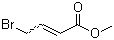 |
| Molecular Formula | C5H7BrO2 |
| Molecular Weight | 179.01 |
| CAS Registry Number | 1117-71-1 |
| EC Number | 214-251-0 |
| SMILES | COC(=O)/C=C/CBr |
| Density | 1.5±0.1 g/cm3 Calc.*, 1.522 g/mL (Expl.) |
|---|---|
| Boiling point | 198.5 °C 760 mmHg (Calc.)*, 219.7 - 222.4 °C (Expl.) |
| Flash point | 67.4±22.6 °C (Calc.)*, 91 °C (Expl.) |
| Index of refraction | 1.485 (Calc.)*, 1.501 (Expl.) |
| * | Calculated using Advanced Chemistry Development (ACD/Labs) Software. |
| Hazard Symbols |   GHS05;GHS07 Danger Details GHS05;GHS07 Danger Details | ||||||||||||||||||||||||||||||||||||
|---|---|---|---|---|---|---|---|---|---|---|---|---|---|---|---|---|---|---|---|---|---|---|---|---|---|---|---|---|---|---|---|---|---|---|---|---|---|
| Risk Statements | H314-H315-H318-H335 Details | ||||||||||||||||||||||||||||||||||||
| Safety Statements | P260-P261-P264-P264+P265-P271-P280-P301+P330+P331-P302+P352-P302+P361+P354-P304+P340-P305+P354+P338-P316-P317-P319-P321-P332+P317-P362+P364-P363-P403+P233-P405-P501 Details | ||||||||||||||||||||||||||||||||||||
| Hazard Classification | |||||||||||||||||||||||||||||||||||||
| |||||||||||||||||||||||||||||||||||||
| SDS | Available | ||||||||||||||||||||||||||||||||||||
 chemBlink Chemical Story
|
Methyl 4-bromocrotonate, CAS 1117-71-1, is an unsaturated ester used primarily as a synthetic intermediate in organic chemistry. It is commonly described as methyl 4-bromobut-2-enoate and has the molecular formula C5H7BrO2. Its structure combines three useful features in a compact four-carbon chain: a methyl ester, a carbon-carbon double bond, and a bromomethyl group. Because these functional elements can participate in different types of reactions, the compound serves as a versatile building block for constructing more complex molecules. The structure can be represented conceptually as BrCH2-CH=CH-CO2CH3. At one end is a carbon bearing bromine; at the other is an ester, with a double bond between them. This arrangement places the bromomethyl functionality in an allylic position and the ester in conjugation with the alkene. As a result, the molecule combines the chemistry of an allylic halide with that of an α,β-unsaturated carbonyl system. The carbon-bromine bond is particularly useful because bromide can serve as a leaving group in nucleophilic substitution reactions. Nitrogen-, oxygen-, sulfur-, and carbon-centered nucleophiles can potentially replace bromide under appropriate conditions, allowing the four-carbon unsaturated ester fragment to be attached to other molecular structures. The double bond and ester can then remain available for subsequent transformations. At the same time, the conjugated alkene-ester portion provides another kind of reactivity. α,β-Unsaturated esters are Michael acceptor systems, meaning that suitable nucleophiles can add across the activated double bond through conjugate addition. Whether a synthetic chemist exploits the allylic bromide, the activated alkene, or performs further transformations of the ester depends on the desired product and reaction conditions. This multifunctionality has made 4-halocrotonate derivatives useful reagents for ring-forming reactions. A linear molecule containing several strategically placed reactive sites can sometimes be converted into a cyclic product when one reaction creates a new bond and a second reaction closes the chain back onto itself. Such strategies are particularly valuable for preparing heterocycles, the ring systems containing nitrogen, oxygen, sulfur, or other non-carbon atoms that are common throughout medicinal chemistry. Methyl 4-bromocrotonate has appeared in published synthetic chemistry involving nitrogen heterocycles and pharmaceutical research. One important type of transformation uses the bromocrotonate chain to introduce a four-carbon unit onto a nitrogen-containing precursor. Subsequent intramolecular reactions can then transform the initially open chain into a ring. In this way, a molecule that begins as a relatively simple unsaturated ester becomes part of a much more elaborate heterocyclic framework. This strategy illustrates an important difference between a synthetic intermediate and a finished functional chemical. Methyl 4-bromocrotonate is generally valuable not because of a particular biological activity of its own, but because its atoms and reactive groups are arranged in a way that helps chemists solve construction problems. The bromine provides a convenient point of attachment, the alkene establishes geometry and additional reactivity, and the ester can remain in the product or be converted into other functional groups. The compound also demonstrates the concept of synthetic handles. Organic chemists often describe a functional group as a "handle" when it provides a predictable location for manipulating a molecule. Methyl 4-bromocrotonate effectively contains several such handles in a very small structure. After substitution of bromide, the double bond may be reduced, oxidized, or involved in addition chemistry. The ester may be hydrolyzed to a carboxylic acid, converted into an amide, reduced, or used in further carbon-carbon bond-forming reactions. Controlling these possibilities is an exercise in chemoselectivity. A reagent selected to react with the carbon-bromine bond should ideally leave the ester and alkene unchanged if they are needed later. In another synthetic sequence, the double bond may be deliberately targeted while the bromomethyl group is preserved. Modern organic synthesis depends heavily on this ability to perform one transformation without disturbing every other reactive feature in the molecule. Unsaturated halogenated esters also require careful handling because their usefulness is inseparable from their chemical reactivity. Alkyl and allylic bromides can react with biological nucleophiles as well as laboratory reagents, and α,β-unsaturated carbonyl compounds may also display electrophilic reactivity. Methyl 4-bromocrotonate is therefore principally a controlled laboratory and manufacturing intermediate rather than a material intended for direct consumer exposure. The broader lesson from methyl 4-bromocrotonate is that molecular complexity does not necessarily require a complicated starting material. A five-carbon molecule can already contain several pieces of chemical information: where another fragment can be attached, where addition chemistry can occur, and which functional group can be transformed later. Chemists can exploit those features sequentially until the original small molecule is almost unrecognizable within the final structure. Methyl 4-bromocrotonate is therefore a useful example of molecular economy in synthetic chemistry. Bromine, a double bond, and an ester are packed into a short carbon chain, with each feature providing a different opportunity. What appears to be a simple intermediate is actually a compact set of instructions for building something larger. References 1. PubChem. Methyl 4-bromocrotonate, CAS 1117-71-1. Chemical identity and physicochemical information. 2. Larock, R. C. (1999). Comprehensive Organic Transformations: A Guide to Functional Group Preparations, 2nd ed. Wiley-VCH. Reactions of allylic halides and α,β-unsaturated esters. 3. Smith, M. B.; March, J. (2007). March's Advanced Organic Chemistry: Reactions, Mechanisms, and Structure, 6th ed. Wiley. Nucleophilic substitution, conjugate addition, and synthetic chemistry of unsaturated carbonyl compounds. 4. Otera, J.; Nishikido, J. (2010). Esterification: Methods, Reactions, and Applications, 2nd ed. Wiley-VCH. Synthetic transformations and applications of ester functionality. |
| Market Analysis Reports |