
Online Database of Chemicals from Around the World
| Suzhou Myland Pharm & Nutrition Inc. | China | |||
|---|---|---|---|---|
 | www.mylandpharm.com | |||
 | +86 (512) 6615-0687 | |||
 | +86 (512) 6615-7101 | |||
 | info@mylandpharm.com | |||
 | QQ Chat | |||
| Chemical manufacturer since 2013 | ||||
| chemBlink Standard supplier since 2014 | ||||
| Classification | Organic raw materials >> Ketone compound |
|---|---|
| Name | Dehydrozingerone |
| Synonyms | (E)-4-(4-hydroxy-3-methoxyphenyl)but-3-en-2-one |
| Molecular Structure | 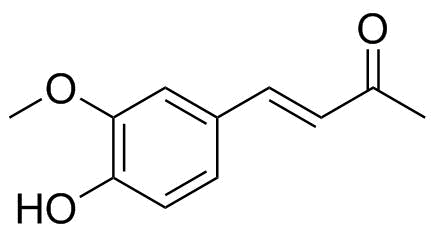 |
| Molecular Formula | C11H12O3 |
| Molecular Weight | 192.21 |
| CAS Registry Number | 1080-12-2 |
| EC Number | 214-096-9 |
| SMILES | CC(=O)/C=C/C1=CC(=C(C=C1)O)OC |
| Density | 1.2±0.1 g/cm3 Calc.* |
|---|---|
| Melting point | 125 - 130 °C (Expl.) |
| Boiling point | 348.2±27.0 °C 760 mmHg (Calc.)* |
| Flash point | 136.9±17.2 °C (Calc.)* |
| Index of refraction | 1.58 (Calc.)* |
| * | Calculated using Advanced Chemistry Development (ACD/Labs) Software. |
| Hazard Symbols |  GHS07 Warning Details GHS07 Warning Details | ||||||||||||||||||||||||
|---|---|---|---|---|---|---|---|---|---|---|---|---|---|---|---|---|---|---|---|---|---|---|---|---|---|
| Risk Statements | H302-H315-H319-H335 Details | ||||||||||||||||||||||||
| Safety Statements | P261-P305+P351+P338 Details | ||||||||||||||||||||||||
| Hazard Classification | |||||||||||||||||||||||||
| |||||||||||||||||||||||||
| SDS | Available | ||||||||||||||||||||||||
 chemBlink Chemical Story
|
Dehydrozingerone is a naturally inspired phenolic compound structurally related to zingerone, one of the pungent constituents associated with ginger-derived chemistry. It is commonly described as a vanillyl-containing α,β-unsaturated ketone and is sometimes referred to as a half-analogue of curcumin because its structure resembles one side of the curcumin molecule. Its chemical framework contains an aromatic ring bearing methoxy and hydroxyl substituents linked to an unsaturated ketone side chain. Structurally, dehydrozingerone contains several important functional elements: a phenolic hydroxyl group, a methoxy group, and an α,β-unsaturated carbonyl system. The phenolic hydroxyl group can participate in hydrogen bonding and contributes to antioxidant behavior, while the methoxy substituent influences electron distribution within the aromatic ring. The conjugated enone (α,β-unsaturated ketone) system is strongly electron-delocalized and represents the most chemically reactive portion of the molecule. The conjugation extending from the aromatic ring through the carbon–carbon double bond and carbonyl group gives the molecule a stabilized π-electron system. This conjugated arrangement influences optical properties and chemical reactivity. The β-carbon of the enone system can undergo nucleophilic addition reactions, including Michael-type reactions, making the compound useful as a synthetic intermediate. Dehydrozingerone has attracted considerable interest in medicinal chemistry and natural-product research because of its structural similarity to curcumin. It has been investigated in experimental studies for antioxidant, anti-inflammatory, antimicrobial, and other biological activities. Much of this research uses dehydrozingerone as a scaffold for preparing analogues with modified properties. Its relatively simpler structure compared with curcumin has made it useful for structure–activity relationship studies. From a synthetic perspective, dehydrozingerone is commonly prepared through condensation reactions involving vanillin derivatives and ketone precursors. The compound is also used as an intermediate for the synthesis of heterocyclic compounds and biologically active molecules. Physicochemically, dehydrozingerone has both hydrophilic and hydrophobic characteristics. The aromatic ring and conjugated chain contribute hydrophobic character, while the hydroxyl and carbonyl groups increase polarity and hydrogen-bonding capability. This balance influences its solubility behavior and interaction with biological systems. Overall, dehydrozingerone is a conjugated phenolic ketone of considerable interest in synthetic and medicinal chemistry because of its reactive enone system, relationship to curcumin chemistry, and use as a versatile molecular scaffold. References 2026. The Fluidized Bed Coating Strategy for Developing Curcumin Solid Dispersion Pellets with Enhanced Solubility and Stability. Journal of Pharmaceutical Innovation. DOI: 10.1007/s12247-025-10307-x 2025. Therapeutic effects of curcumin on seizure and its mechanisms of action. Inflammopharmacology. DOI: 10.1007/s10787-025-02053-w |
| Market Analysis Reports |